Nymans Garden: The West Sussex gem that's been at the cutting edge for over 120 years
Nymans Garden in West Sussex is one of Britain's great horticultural wonders, and with its relatively-new head gardener – only the fifth in over 120 years – now bedded in, George Plumptre paid a visit.

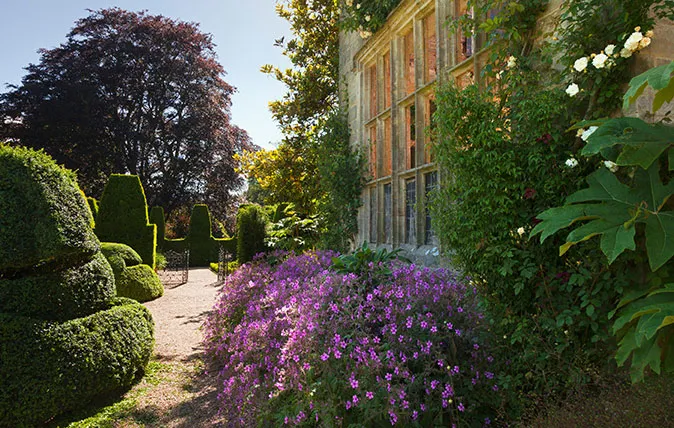
In 1895, James Comber became the first head gardener to be employed by Ludwig Messel, who acquired West Sussex’s Nymans in 1890. It says a lot for the stability and continuity of Nymans that the present head gardener, Stephen Herrington, who has been in charge for the past four years, is only the fifth head gardener at the estate since 1895.
Messel had the largesse and energy that typified the Edwardian garden-making era and much of Nymans’ reputation rests on its exceptional plant collection, gathered on a series of overseas collecting trips by Comber’s son Harold.

This, combined with Comber’s management and propagating skills, propelled Nymans into the vanguard of 20th-century gardening in Britain – a position further secured by Messel’s son, Leonard. William Robinson and Gertrude Jekyll both visited and the Messels corresponded with Lawrence Johnston at Hidcote, which was also being developed at that time.
Within a grand structural framework of trees and architectural features that typified the period, new plants also arrived from expeditions by two other distinguished plant collectors, Frank Kingdon Ward and George Forrest.

Between them all, over nearly three decades, they collected from far and wide – the Andes, the Himalayas, South America, South Africa and Tasmania – as Nymans established a reputation for rare and outstanding plants.
The National Trust took on the garden in 1953, six years after the main house was almost destroyed by fire. Much of the latter only survives now as a sombre shell.

Mr Herrington is constantly responding to the garden’s heritage and, as he says, ‘working to keep alive the real tradition of wild origin and species collection’. It means that he aspires to a balance between the quantities of cultivars and species in the garden.
He is also deftly balancing conservation with new development. On the one hand, he keeps an eye on the healthy survival of the garden’s 37 Champion trees and of the collection of Chilean trees and shrubs that came back from Comber’s expeditions in the 1920s (when he collected some 3,000 plants). Planted beneath sturdy sheltering walls at Nymans, it is the second largest Chilean collection in Britain, after the Royal Botanic Garden in Edinburgh, and includes choice rarities – some of which have beguiling or evocative names.

These include Blepharocalyx cruckshankii, known as Heaven Scent, which has superbly patterned, orange bark; Colletia cruciate, described in one nursery catalogue as ‘a vicious little evergreen shrub from Patagonia with delicious almond-scented flowers beloved by all self-respecting butterflies with a healthy disregard for their own safety’; Crinodendron patagua is known as the lily-of-the-valley tree, the pure-white flowers of which contrast with the bright-red ones of its better-known cousin, C. hookerianum. Weinmannia trichosperma is a handsome evergreen that grows to a height of 100ft in the wild, its small white flowers producing delicious honey.

When energising the garden with new developments, Mr Herrington ensures that they’re done in a manner that’s true to the Messel family’s original ambitions, priorities and interests.
A good example is the wild garden, which he’s looking to expand by three acres, using predominantly mixed native woodland enlivened with more exotic introductions from overseas – exactly as the Messels would have done.

The Messels built up an enormous collection of South African plants, grown mainly under glass; most of them no longer exist in the garden, but are listed in its inventory, Nymans Flora of 1918.
To go in its place, Mr Herrington is developing a new area of South African borders to re-create the spirit of the original, but with hardy outdoor varieties such as the airy grass Pennisetum villosum Cream Falls, a spectacular orange red-hot poker, Kniphofia Mango Popsicle, and different restio grasses.

Another new area being developed close to one boundary of the garden is something of an homage to Comber’s Antipodean collecting. The Australia Dry Garden is planned as a living embodiment of ‘no maintenance’ horticulture – the plants were watered once when put in and have not been since.
Visitors familiar with some Australian plants will delight in previously unknown curiosities, such as the strong-smelling Dianella tasmanica with its small white flowers, the ‘sea rosemary’, Ozothamnus rosmarinifolius Silver Jubilee, and the luxurious, broad-leaved bottlebrush, Banksia robur, all of which are as distinctive-looking as you would expect from a trio of Australasian rarities.
Mr Herrington is ensuring that Nymans is a pioneer of Green gardening. No water is taken from the mains and the garden uses only recycled rainwater. Hand tools are all battery powered and the tractors run on bio-diesel. No chemicals have been used for three years, which, in some areas, has affected the varieties of plants grown, for instance, in the rose garden, where David Austin roses are being phased out and replaced with a growing collection of older cultivars and species.

With such a richly varied collection of trees and shrubs, Nymans has always been a garden with wonderful spring and autumn displays in addition to its midsummer zenith. However, Mr Herrington regularly looks for ways to strengthen this diversity and a good example is the salvia triangle he has planted in an area close to the main entrance, which he’s building up over three years to provide a spectacular display of colour into September that will draw admiring visitors to the garden.
As big a challenge as anything is keeping on top of the sheer scale of the garden. Every year, the famous double borders that form the centrepiece of the walled garden are filled out with 6,000 half-hardy and tender annuals grown in the glasshouses.

In an operation of military efficiency in the first week of June, they’re all planted out and staked with hazel twigs. The annuals are planted in the front sections with taller perennial plants behind.
At the end of the season, an assessment is done of all plants’ success or failure; after the first frost, the annuals are taken up and the taller perennials left to provide seeds for birds and continuing autumn interest. Closer to the house, 3,000 tulips are planted in the sunk garden annually, mixed with Winter Orchid and Winter Passion wallflowers.
It would be easy to be intimidated by Nymans’ illustrious past, reminders of which are everywhere in the garden. One of the rarest magnolias is Cecil Nice, named after the second head gardener.

Not only is there a rare cultivar of the pocket-handkerchief tree, which was named after the garden – Davidia involucrata Nymans Sentinel – but, towards one edge of the space, there is a whole grove of davidias interspersed with great clumps of cloud-clipped box. There are Camellias Leonard Messel and Maud Messel and, perhaps best known of all, Magnolia Leonard Messel.
Nymans remains an internationally important horticultural aristocrat whose lineage is being rejuvenated with youthful vigour that makes it as relevant to the priorities and conditions of the 21st century as it was to those of its early-20th-century origins.
Nymans, at Handcross near Haywards Heath, West Sussex, is open year-round; for further information, telephone 01444 405250 or visit www.nationaltrust.org.uk/nymans.
Little Mynthurst Farm: A rare mid-20th-century garden designed by Russell Page
George Plumptre enjoys the grounds of a Tudor farmhouse that was the former home of Lord Baden-Powell. Photographs by Clive

What next for Clandon Park? Time to breathe life back into this great house
Simon Jenkins, former chairman of the National Trust, considers the next steps for Clandon Park in Surrey, two years after
West Sussex house with magical garden and lake
This West Sussex house was originally built as a coach house and stables, and now boasts a magical walled garden

Knowle Hill Farm, Kent: The hilltop garden to enjoy winter and early-spring flowers
A windy hilltop was no deterrent to the owners in creating a garden with a special focus on winter and

Credit: Getty - Sheffield Park - a Capability Brown landscape
The last word on Capability Brown – but one which comes with a health warning
This book on Lancelot 'Capability' Brown by the greatest living expert on his work is like nothing else – but it
