'A garden that dazzles by its colour and orderly perfection': Highnam Court's 30-year labour of love
The gardens of Highnam Court in Gloucestershire — the home of Roger Head — were unused, eroded, neglected and overgrown 30 years ago. Since then they have undergone a miraculous transformation, says Timothy Mowl. Photographs by Clive Nichols.


The gardens at Highnam Court, west of Gloucester, began to take shape when the estate was bought in 1838 by Thomas Gambier Parry, a rich young man with inherited wealth from his family’s East India Company connections. He found the grounds around the rare Commonwealth house in a desultory, part-formal, part-Capability Brown condition. The stew ponds and ‘Great Pool’ shown on an estate plan of 1757 had been reduced to a series of rectangular canals below the house, flanked by two slim lakes bordered by tree belts, with a serpentine plantation of trees cutting down and through an expanse of bare grassland.
Gambier Parry was a hyperactive artist, collector of early Italian paintings and philanthropist. He commissioned Henry Woodyer to design a new parish church as a memorial to Parry’s first wife, Isabella, its High Victorian interior enriched by frescos painted by Parry himself. He also added a rectory, a school and five lodges to the estate and re-routed the drive to make the blank, north side of the house its formal entrance. The old entrance front became the garden façade facing south, with a balustraded terrace added by the architect Lewis Vulliamy, who oversaw the alterations. A formal East Garden with a conservatory, a sunken South Garden, a Winter Garden Terrace and Winter Garden were added, this last one of the earliest and most engaging Pulhamite gardens in the country.

A maze of paths through fabulous Pulhamite outcrops (one with a crocodile perched on top) is designed to disorientate the walker in the Winter Garden.
In 1992, however, a survey and report by Singleton Landscape found the house unused, the lakes silted and eroded and the gardens sadly neglected and overgrown. Highnam’s saviour was Roger Head, a local Gloucester businessman, who bought the estate in 1994 and set about a miraculous restoration of the house and the Pulhamite garden. Thirty years on, his transformation of Highnam is almost complete — although he keeps planning new garden extensions — and in sunshine the place almost dazzles by its colour and orderly perfection.
Driving in by the Chepstow Lodge off the A40, a visitor hears the cheerful sound of a picturesque waterfall, plunging down Pulhamite stone under the bridge that arches over the river that waters the grounds so generously. The drive then threads through a typical Victorian parkland of specimen trees — pines, sequoia, ash, oaks, liriodendron, cedar of Lebanon, one majestic plane — a restless muster of green silhouettes, interspersed with Dr Head’s favourite acers.
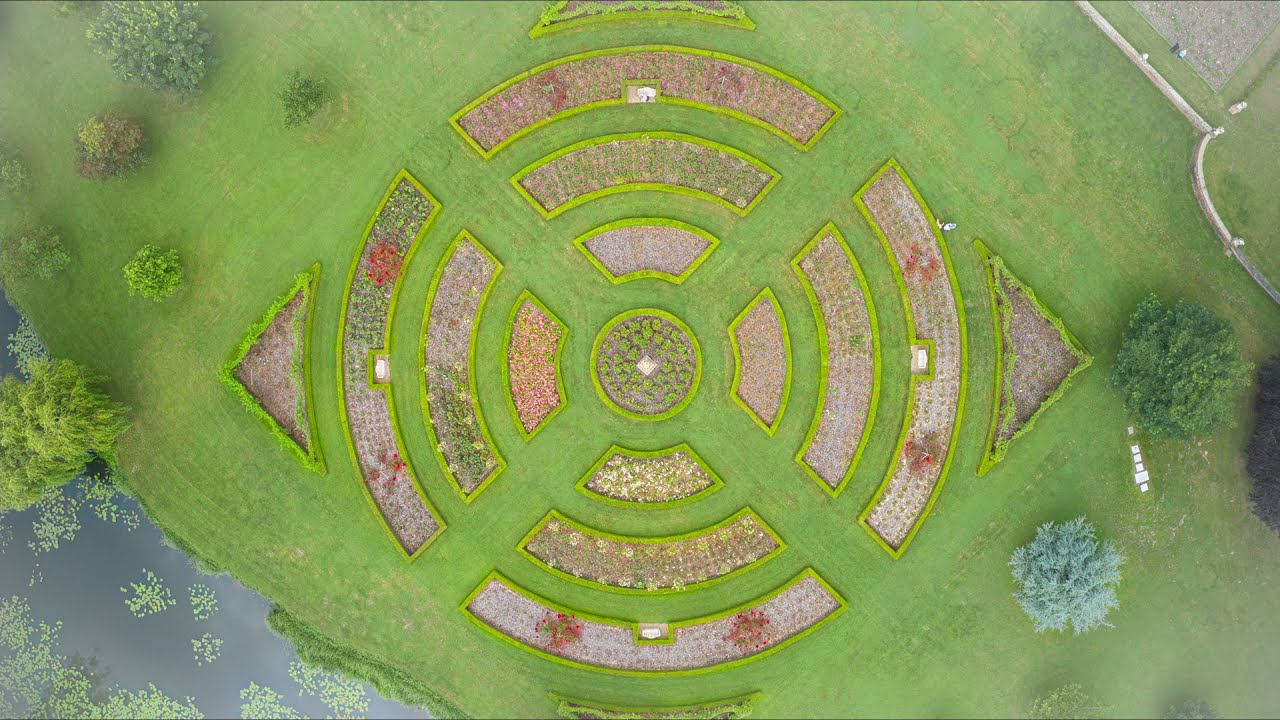
Entry to the grounds from the house is via a brick wall into the East Garden. Set into a niche, which was once within a demolished conservatory, is Oliver Cromwell, half-nude, half-Roman, posing as Hercules. The statue was originally in the niche over the south door, but political considerations banished him after the Restoration of 1660. He was brought here from exile in the stable court in 1920 and now looks out over a formal garden punctuated by Parry’s Irish yews. His place on the south façade was taken in 1962 by a statue of Flora, which formerly stood on the Winter Garden Terrace. The lawn down to the lake is now a circular blaze of roses, laid out in concentric box-edged beds.

The main lawns in front of the rare and now fully restored Commonwealth house are ablaze with roses in box-edged beds.
Every path at Highnam is of golden gravel and their grass borders are shaved to perfection. Throughout, a wonderful neatness and cleanliness refreshes every view. The wisteria-clad arbour of the Broad Walk leads west towards the walled former kitchen garden and passes a new orangery, which Dr Head has added to the house to balance the former billiard room on the east side. Outside the orangery there is a knot garden, whereas inside are two survivors of the Pulhamite urns from the Winter Garden Terrace.
The firm of James Pulham and Son of Broxbourne in Hertfordshire was brought in by Parry in 1849 and worked here until 1862. James Pulham had devised an ingenious process for making lightweight, but natural-looking boulders by applying Portland cement to bricks and clinker, colouring it, spraying tiny pebbles to imitate sedimentary deposits and then laying out ‘rocks’ in imitation of natural stratification.
The firm would often mix its anthropic rockwork with real stone from the area; one of the pleasures of Highnam is trying to distinguish Pulhamite from Forest of Dean sandstone. It is not easy. Pulham was so proud of one of his arrangements at Madresfield Court in Worcestershire that he signed it as a work of art. There are further Pulhamite outcrops on the approach to Waddesdon Manor in Buckinghamshire. These artificial rockeries were not intended for planting with delicate flowery alpines, but with ivy, ferns, conifers, rhododendrons, brooms and even gorse.
The Winter Garden Terrace is bordered by the kitchen garden wall on one side, with more Irish yews, and on the other by a row of sentinel polycarbonate obelisks by Robert Bryant, which appear to change colour as you pass, backed by roses. Further out, there are more deep borders with more roses.

The Winter Garden Terrace with Irish yews against the kitchen garden wall and colourful polycarbonate obelisks by Robert Bryant.
The gravel path leads to the Pulhamite Owl Cave and down into the Winter Garden, which is really a vast rockery of mazy paths licked by ferns and threaded by tiny streams crossed by a rockwork bridge. The paths skirt a central pool with an island on which is a secret grotto. Shrubs and flowers are present, but not intrusively so; there are swamp cypresses, bamboo, acers and eucalyptus. The charm of it all is to follow the steps and golden gravel to catch glimpses of the grounds outside. The excellence of the planning is that it draws a visitor in to lose their sense of direction and make sudden discoveries.
Beyond a rocky Pulhamite outcrop, where the brickwork armature of the artificial stone can be seen, a lake has been made from a withy bed, its graceful bridge a replica of Monet’s at Giverny. Dr Head is planning a new garden alongside and has already laid out a Spiral Mound Garden topped with a shell sculpture by Mat Chivers, carved from Kerry limestone. The mound itself is a beehive design by the late Carolyn, Lady Elwes, of nearby Colesbourne Park. It is encircled by beds planted with 12,000 plants, pastel shades in the inner beds and hot colours in the outer.
Walking back past the Winter Garden and the Rose Garden, the new Lower Lake comes into view. This was illustrated in Rudder’s 1778 History of Gloucestershire (Country Life, May 12, 1950), but had eroded beyond recognition by the time Dr Head arrived. He had a battle to get permission for its reinstatement, but Tewkesbury Borough Council overruled English Heritage, agreeing with Dr Head that it would complement, rather than disfigure, the Highnam landscape. It fits so perfectly into the grounds that, like the Pulhamite rockery, it could easily be mistaken for the genuine article.
One other leitmotif of this remarkable transformed landscape are the animal sculptures, carved by David Bytheway from dead trees, that enliven the views. The most impressive is one of leaping horses commemorating a visit made by the then Prince of Wales in November 2010. It also celebrates composer and musician Hubert Parry, Parry’s second son, famous for his setting of William Blake’s poem Jerusalem, who succeeded to the estate in 1896. A fitting tribute to Dr Head would be to quote that great choral anthem — he has achieved at Highnam a brilliant evocation of England’s ‘green and pleasant Land’.
Highnam Court is open on select days throughout the year for the National Garden Scheme — see their website for more details. The garden also
This feature originally appeared in the September 30, 2026, print edition of Country Life. Click here for more information on how to subscribe.
