'Grow some balls and jump a clear round': Scott Brash and Harry Charles on grit, Grand Slams and growing up in the saddle
Susanne Madsen meets the master and the new kid on the block of British showjumping.


Even the world’s best equestrians aren’t exempt from some blunt riding instruction. Much of it, Scott Brash says, can’t be repeated in Country Life, but the Olympic gold medallist and gentle horseman extraordinaire received a memorable one-liner at his first-ever Nations Cup at La Baule in 2010, where Brash had help with his horse from his teammate Peter Charles. ‘Just as I was trotting into the ring, Peter was behind me and said, “Scott, Scott, stop, stop, stop!” I stopped and was like, “what’s wrong?” And he said, “Grow some balls and jump a clear round, will you?”’
Sixteen years later, Brash is a steady purveyor of clear rounds. They are fluidly delivered, with calm and quiet riding on horses he imbues with beautiful lightness and elasticity. He is also something of a unicorn: in 2015, the Scotsman became the first and so far only rider in history to claim the mythical Rolex Grand Slam of Show Jumping trophy with his horse Hello Sanctos, by consecutively winning the CHI Geneva, the CHIO Aachen and the CSIO Spruce Meadows ‘Masters’ in Canada. Newly announced as a Rolex testimonee that same year, Brash certainly made quite the entry into the Swiss luxury watchmaker’s family of top athletes.

All of Brash's top horses carry the 'Hello' prefix — a trademark by his long-term supporters Lord and Lady Harris and Lord and Lady Kirkham.
‘Yeah, that was good timing,’ Brash says with a chuckle. ‘Being part of history, it’s quite surreal when you think back about what you've achieved and how difficult it is to do. I’d like to think it’s not changed me. I still think I approach each horse differently as individuals. I’m still as hungry as ever to go and win it again.’ Supported by Lord and Lady Harris and Lord and Lady Kirkham, this month, Brash’s eye is on the Spruce Meadows ‘Masters’, the world’s biggest Grand Prix, which he has won a record three times (September 9-13). ‘It’s the place I watched as a kid on TV growing up, thinking I’d love to compete there one day.’
When we meet up on home turf at the Royal Windsor Horse Show, Brash and his chestnut mare Hello Folie have just jumped clear in the 1.55-metre Defender Stakes. As soon as they’re over the last fence, Folie walks out on a long rein in a stretchy, relaxed outline that would thrill any biomechanically nerdy horse person. ‘She’s so cool in her brain. When she goes in the ring, she comes alive and loves jumping, but the minute you finish, she’s so calm,’ Brash says, stroking the mare’s face as she enjoys a hay net in her stable hotel room after withdrawing from the jump off. ‘She jumps the Grand Prix on Sunday, so I thought there’s no sense for her to gallop round this. She’s done good.’


It’s this sort of horsemanship that makes Brash a standout rider. To Harry Charles, son of Peter Charles and one of the leading young showjumping talents shaping the future of the sport, Brash has always been a role model. ‘Naturally, as a young kid with a dream of doing this, you idolise someone, and Scott was that for me,’ Charles says when he joins us. ‘I could tell you if it was a silhouette going around, that’s Scott. I wish I could make all my horses go the way I’d like to. But Scott can do that so easily and so effortlessly. And he lets each horse go in their own way. He doesn't try to force anything.’
When Charles first joined the big show circuit, Brash was the one who made him feel welcome and would sit with him at breakfast and ask how it was going. ‘And I’m happy now even to call him a very good friend,’ Charles says. In 2024, they won Olympic gold together, a repeat of Brash’s London 2012 feat with Papa Charles. ‘Harry has always been a very good rider, even from the 12’2 days,’ Brash says. ‘Coming into the top sport and being in the Olympic games as a young person, he coped really well with those situations. And he thrives under the pressure now. His whole riding has become very one. He has a very, very top future ahead of him.’

Charles on Sherlock at the 2026 Royal Windsor Horse Show.

Charles in his Rolex Land-Dweller.
If their schedule allows, Brash and Charles can be spotted on the golf course together. ‘He’s fantastic. I’m terrible,’ Brash says of their game. As a fellow Rolex cohort, Charles — who was snapped up as a teenager by the watchmaker to become their youngest ever equestrian testimonee — quips he hopes Rolex will stay with him when he pivots to golfer. Rolex hasn’t just kept time for him all these years, but also limbs. When Charles fell off at a wall in Aachen in 2022, the main horseshoe stud went straight through the bracelet of his white gold Sky-Dweller, breaking the bracelet but saving his wrist. He went on to win bronze with Brash and Ben Maher at the World Championships three weeks later.
Neither Brash nor Charles learnt to ride on ready-made ponies but had to get on with it onboard the self-governing kind. ‘I wasn’t appreciative at the time, but now I’m so lucky I was made to,’ Charles says. Brash, who was seven when he caught the horse bug, on a pony shared with his sister, had the same. ‘Lots of different ponies that were tricky and naughty, but it really taught you to ride. And understand the horse you have.’
To this day, it’s the Brash way: ‘Play to the strengths and work on the weaknesses,’ he says, noting that while a slower or bigger horse might need more time on a rollback turn, they can take a stride out down a long line to win time. Time, of course, is of the essence in a discipline where milliseconds decide a winner, which makes Rolex’s involvement no coincidence. ‘I’ve always thought of it as a reaction sport,’ Charles comments. ‘Obviously you can have a plan. But if a horse jumps a bit left or goes a bit high, a bit forward, you've got to make instinctive decisions really fast. Especially in a jump off. We feel if we’re a bit behind, and then your plan maybe has to change in a split second.’

Charles won team jumping gold at Paris 2024, alongside his father's 2012 teammates, Ben Maher and Brash.
Outside the ring, they both say horses respond best when you don’t look at the clock. ‘It’s a balance, and it’s knowing when the horse is ready to put that sort of pressure on them,’ Brash says, adding: ‘Sometimes we can make a mistake and set them back a bit. But then you take a step back to move forward later on. Horsemanship is so important, to produce those moments in time.’ At home, Brash does lots of hacking as the horses see enough schools at shows. His less-is-more style is shaped by his start in the landscape of Peebles, where — in lieu of an indoor school or arena — he would ride up and down the Scottish hills and through a river on the farm.
‘I could still have the horses very fit going to a show, probably fitter than a lot of the other riders. It’s more natural for them. And when they're happy, they love it.’ Mindful of the sport’s increasing travel, he is careful not to get into ‘that hole of chasing ranking points. When a horse is good, it’s easy to be jumping in Shanghai last week and be here this week. You’ve got to pick and choose; the horse can’t do everything. They’re not machines.’

Rash with Hello Forever (left) and Hello Sanctos (centre) at his family home in Scotland.
What would Brash and Charles like to see more of in the horse world? ‘A bit more patience,’ Charles says, noting that his family don’t back their horses until around the age of five. ‘You never know with so many horses what it could have been if they weren't galloped at these young horse championships as a five-year-old.’ And, he adds, a little less focus on the glitz and glamour of horses that the media sometimes focuses on. ‘We’re out in the mud, the rain, turning all the foals out in the field. They’ve been bred literally in our gardens. But they want the VIP and the who’s there, which is a shame because that’s a very small proportion of our sport. That’s not why we do it.’
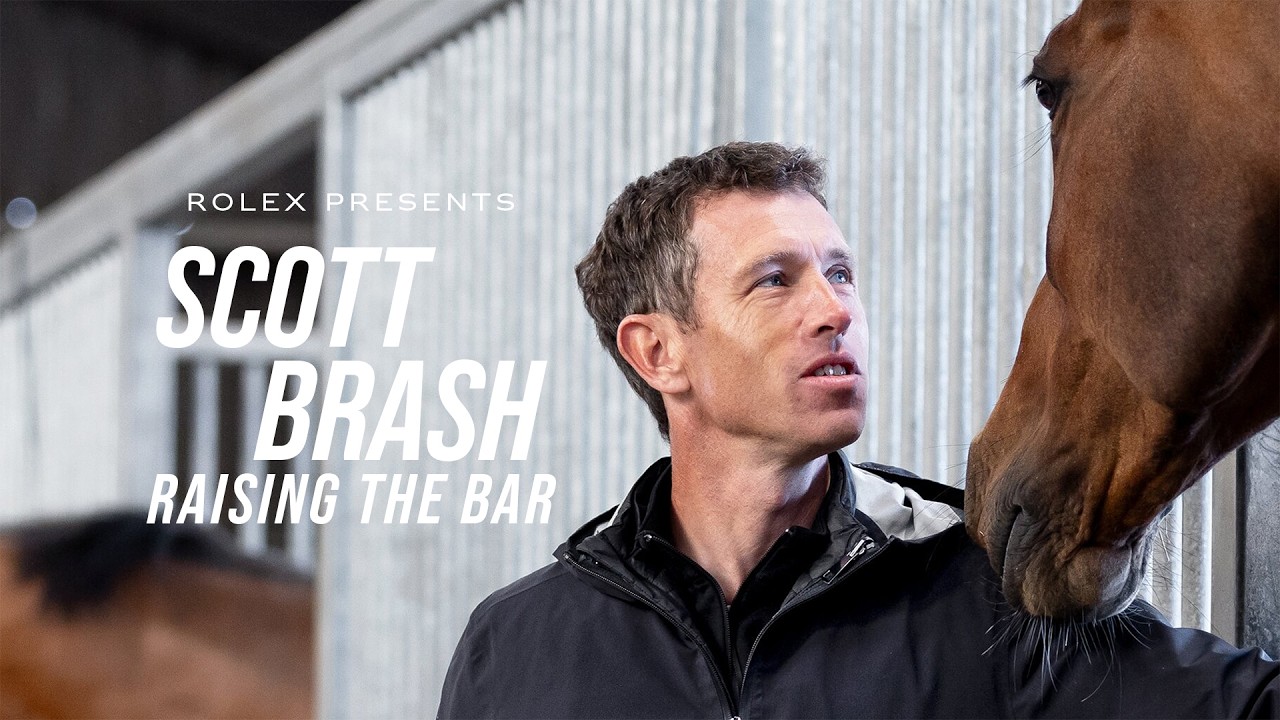
‘They are our life,’ Brash adds of their bond with the horses. ‘They’ve taken us around the world, into scenarios, that, good and bad, have taught us about life.’ They will also surprise you, like Hello Sanctos at the London Olympics. ‘The first day going in, I could feel his heart pounding out of his chest. I thought, oh God, how’s the week going to go now because of this enormous atmosphere? But that showed what an amazing character he was, because every day he grew and got better and better.’
What continues to floor Brash is the trust horses have in us, like a young horse following you onto a horsebox for the first time. ‘They’re incredible, amazing creatures who really want to please us in whatever we’re trying to do in life. Different horses teach us different things. I’m still learning.’
