Down with the breakfast meeting
Will Hosie has been a breakfast refusenik since he first learnt the joy of lying in. As Londoners flock to breakfast meetings, can he bring himself to join in the fun?


The first picture that appears on the Wikipedia article for 'Breakfast' is ‘a typical American breakfast, composed of a waffle, fruits, juice and scrambled eggs’. The meal in front of me at Simpson’s In The Strand looks rather different. Styled on the menu with a cartoon of a Devil’s head, it is called The Ten Deadly Sins. For the princely sum of £28.75, one is served the following: eggs any style, Cumberland sausage, streaky bacon, black pudding, lamb chop, devilled kidneys, bubble and squeak, grilled tomatoes, mushrooms and fried bread. As my colleague James Fisher put it: ‘Ah yes: you ordered the gout express.’
Breakfast, we are often told, is the most important meal of the day. The catchphrase was first cooked up by Lenna Cooper in Good Health magazine and later lionised by Dr Kellogg of Kellogg’s Cereal. It is catchy, but it’s also nonsense: nutritionists are quick to call the aphorism a mere marketing tool and Prof Tim Spector, founder of the health app ZOE, has been vocal about the lack of clinical evidence suggesting that breakfast is more important than lunch. The Ten Deadly Sins would suggest that it isn’t especially virtuous. Why, therefore, am I here?
I am putting to test a theory that breakfast meetings are the best way to start one’s day. A press release recently informed me these were making a comeback in the capital and, although Londoners’ overall excursions to the restaurant have decreased in the past few years, breakfast outings have held steady. In a few lucky spots, they’ve even multiplied. Advocates of the breakfast meeting believe it offers something the lunch-hour talk cannot: a clear head, unencumbered by the tasks that pile onto one’s desk the moment one reaches the office and a feeling of carpe diem.
'Breakfast meetings are chic. You achieve something before the rest of the world gets going'
‘Breakfast meetings are chic,’ says Ed McGovern, a theatre producer. ‘You achieve something before the rest of the world gets going.’ It also encourages participants to have an early night and get their inbox down to zero so that the influx of messages that lands during breakfast does not end up tipping an already heinous number over the edge. What of the other draws? ‘It’s a smart way to take out someone for a meeting who you wouldn’t necessarily want to spend more than one hour with,’ says a source. McGovern confirms that breakfast meetings ‘typically last no longer than 45 minutes’.
You might think that, sooner or later, people would cotton on to the fact that some are using breakfast meetings as an avoidance strategy — a polite way of telling someone that they are second rate. ‘This is one of the reasons why I hate breakfast meetings,’ Fisher says — and he’s not the only one. ‘The other day, a contact from the motoring world asked me to a breakfast meeting and I suggested, instead, that we have a drink after work. Not only did he agree to it: he seemed relieved.’ Why suggest the breakfast meeting in the first place? ‘It’s a safer bet,’ Mr Fisher admits. ‘It is seen as unintrusive, inoffensive and risk free; the right choice, professionally.’
As someone who is categorically not a morning person and for whom the first two hours of the day have long been held sacred, a breakfast meeting seems inherently more intrusive than a pint after the working day. In truth, I have been a refusenik for close to 10 years, my mornings consisting of a glass of water and a coffee ever since I discovered the joy of going out and lying in at university. With so many now singing breakfast’s praise, however, I reasoned it would be professionally negligent not to try it out for myself.

The Full English. Delicious, but perhaps a bit over the top for a breakfast meeting.
'Thou shalt not order yoghurt, granola or avocado on toast, but try the star meal on the menu each time'
Thus, I resolved to take a different breakfast meeting every day for an entire working week, inviting several experts to join me in my quest — with all of whom I would happily spend more than one hour. I prioritised those I knew would keep me most entertained at a time when I am usually still half asleep. Finally, I laid down some ground rules. One: thou shalt not order yoghurt, granola or avocado on toast, but try the star meal on the menu each time. Two: thou shalt choose a spectrum of establishments to study the range of early punters and how they interact with one another. (Is their heart truly in it?) Three: Martino’s, SW1, being close to thy house and among the less gouty options, shall bookend thy week of breakfasts in the hope of not developing scurvy. Four: thou shalt skip lunch wherever possible and exercise more than usual.
In between my trips to Martino’s, I decided to pay a visit to Simpson’s, WC2 — the grande dame of Zone 1 — then Claridge’s, W1, and, finally, the Regency Café, SW1. ‘I love it here,’ says Hannah Crosbie, The Observer’s wine critic, whom I take along to the latter. ‘But, you know Will, I don’t normally eat breakfast.’ Why? ‘Something about eating puts me in an inherently relaxed mood,’ my companion explains. ‘It signals to my body that I am now not working; that I need to rest; in short, that I am off.’
Crosbie is far from the only one to admit, once seated, that the most important meal of the day isn’t their usual cup of tea. ‘I so rarely do it, either,’ says Adam Hyman, founder of Code Hospitality, as we tuck into a pre-Ten Deadly Sins honeycomb crumpet at Simpson’s on Tuesday. The commonly held view seems to be that breakfast, on its own, is a bit of a waste of time, but incorporating a meeting into it gives the first meal a purpose.
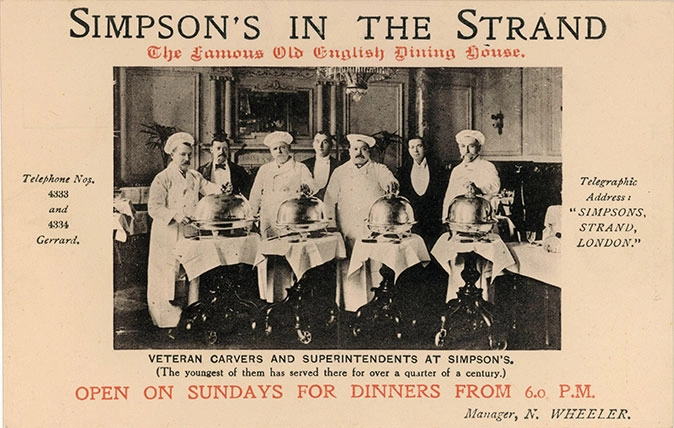
Simpson's-in-the-Strand has been one of London's finest dining rooms since 1848.
The Regency Café hums with life when Crosbie and I arrive just after 9am. It is stocked to the brim with tourists, tradesmen and a few locals from the Grosvenor estate. ‘Please order at the counter — and wait for your number to be called’ reads a blackboard hooked above the menus. I opt for the most popular order: the set breakfast deal, consisting of a fried egg, two rashers of bacon and a sausage served with either beans or tomatoes; tea or coffee; and toast or bread (£9.99). Crosbie orders fluffy scrambled egg whites with mushrooms, bacon and a Cumberland. Can I learn to love this? It’s 30˚C outside: hardly breakfast-friendly weather.
The atmosphere inside is warm and convivial: a good spot for a natter, although not entirely conducive to the breakfast meeting’s more habitual trappings. For one thing, you have to interrupt your conversation to pick up your order when ready. It doesn’t prevent Crosbie and I from talking shop. A professional woman about town, she tells me about the book deal she’s just scored with 4th Estate: a collection of pieces and short stories capturing a moment in the culinary zeitgeist that she is too humble to admit she had a heavy hand in creating. I make sure to write down all her tips.
At the other end of the spectrum is The Foyer at Claridge’s: somewhere that not only means business (Swedish former footballer Zlatan Ibrahimović is a few tables down from us with someone who appears to be his accountant), but where the acoustics are designed for you to hear only the person opposite you. This, naturally, means people are desperate to eavesdrop. My guest, the menswear journalist Nick Carvell, orders an omelette as I tuck into an Arnold Bennett: a hotel menu favourite, alongside the Full English. It is creamy and delicious: Scottish haddock poached in milk, topped with a mustardy béchamel sauce and copious amounts of melted cheese (£32). An iced Americano accompanies this beatific monstrosity.
'The diners communicate in a manner I have only ever seen in five-star hotels and is best summed up by that time-worn phrase: A withering look speaks 1,000 words'
Carvell has just returned from a holiday in Sweden, coincidentally, where his husband was running a marathon, for which a decent breakfast is definitely necessary. ‘I am learning Swedish on Duo Lingo,’ he tells me. ‘It teaches you entirely useless phrases, such as jag älskar pengar.’ ‘What does that mean?’ ‘I love money.’ We laugh and look around: everyone here loves money. The diners communicate in a manner I have only ever seen in five-star hotels and is best summed up by that time-worn phrase: ‘A withering look speaks 1,000 words.’
Claridge’s remains London’s most celebrated hotel for a reason. The room is a mix of both guests and wanderers who planned their breakfast here weeks ahead as if part of a pilgrimage. For Peter Rosengard, a life-insurance salesman after whom a dish is named on the menu — two scrambled eggs, hyper-crispy bacon and toast, which he has been ordering since 1981 — the matter is closer to ritual. This is the spot in which he has chosen to take nearly all his important meetings for the past 38 years. According to The Times, he has hosted as many as 10,367 breakfasts at Claridge’s — which means that, for every 10 days, he’s spent seven to eight in The Foyer closing a deal before most of us have even left the house.
To fully understand breakfast, one has to approach the subject linguistically. The word itself is a corruption of the Latin desjunare (to break one’s fast) — which, before giving us ‘breakfast’, gave us ‘dinner’. The latter was, for a long time, our chief fast-breaking meal, until the advent of lunch in the 15th century meant our largest gap in eating would happen overnight. Understanding which daily meal constitutes the breaking of the fast — and how this varies from culture to culture — might explain why the French like to take a three-hour lunch (desjunare gave them their déjeuner) and eat only a croissant for breakfast as we swallow a Prêt sandwich at our desk at noon and, occasionally, indulge in a Full English.

Tradition comes in many forms. For many, the greasy-spoon aesthetic of the Regency Cafe will always be the true manifestation of breakfast.
Simpson’s In The Strand has all the hallmarks of a place where one might break their fast regardless of which meal they’ve elected to do this in. Hyman and I are here during half-term, which means it’s quieter than usual by the time we arrive at 9am and busier than usual by the time we depart at 10am. ‘City boys like to take their meetings really early,’ he explains. ‘It’s a flex.’ It’s another reminder that I was never cut out for the world of finance or insurance. Words will have to do.
The breakfast at Simpson’s ends up being my biggest indulgence of the week. I learn there and then that breakfast meetings — like all others — are mainly about pace. An omelette is a savvy order, light enough to digest easily, yet giving you lots of energy. Smoked salmon is refined, but comes with the risk of small pieces getting caught between your teeth. An Arnold Bennett is a bold choice — for it is often smelly — although the one at Claridge’s suffers no such problems and is still light enough to leave room for waffles. This should be understood only in proverbial terms: no one should ever order waffles or pancakes during a breakfast meeting that isn’t expressly with a work colleague who has graduated to the status of close friend and confidante and won’t judge you for it.
Finally, The Regency Café is a gem of a spot in which to conduct a surreptitious interview and assess someone’s balancing skills when they carry two trays over to the table. Presumably important if joining the circus or MI6.

Simpson's-in-the-Strand has earned rave reviews for breakfast, lunch and dinner since reopening this year.
The star dish at Martino’s, where my week both begins and ends, is a cacio e pepe scrambled egg with focaccia soldiers. This is soft and buttery, best paired with grapefruit juice and shared with the kind of person with whom you really don’t want to rush a meal. The menu offers an Italian spin on British classics, the baked eggs arrabbiata packing just enough of a punch to serve as a substitute to a Bloody Mary — should one wish to avoid drinking before a client. The room is dotted with the kind of clientele who would once have been called ‘ladies who lunch’, as well as a few tourists in search of postcode supremacy.
I bring along my friend Hugh Rowan, a barrister, for my first outing. He is no stranger to an early breakfast. ‘Dad and I used to eat at Granger & Co down the road from where we lived,’ he explains, ‘leaving the house at 7.15am and getting there for opening. I was working late hours back then and it was a great way for us to spend some time together, as we couldn’t predict when I might get home in the evening.’ I realised that breakfast offers a kind of intimacy that other meals do not. Dinner, which Hyman claims as ‘most people’s big, communal meal of the day’, is a collective endeavour.
Lunch, in this country, is often al desko — and solitary. The common denominator among all my breakfasts this week, from opulent brasseries to local caffs via five-star legends, is the level of access it gave me to the people eating opposite me: pre-emails, pre-stress, simply human beings in their purest form. I return to Martino’s on Friday with Fisher, my fellow breakfast refusenik, and we order pancakes.
This feature originally appeared in the July 1, 2026, issue of Country Life. Click here for more information on how to subscribe.
