The Hippie Porsche is the pinnacle of performance and psychedelic power
A car developed to dominate Le Mans was revolutionary in more ways than one, and once again set tongues wagging at the Goodwood Festival of Speed.


Standing out at the Festival of Speed is not the easiest thing to do. But painting your Porsche in the style of a particularly raucous acid trip is one way to do it. It is, of course, one of life’s great questions: how do you make a Pagani look plain? The answer, it would seem, is to seek inspiration from the Summer of Love.
In 1970, Porsche knew that their 917 was underpowered when compared to the other giants of Le Mans, and so it was that the Long Tail (or ‘Langheck’) was developed, specifically for the straights of the famous 24-hour race. Innovation is the key to success, and when the 917LH hit 240mph down the Mulsanne straight, it became clear rather quickly that what Porsche couldn’t solve with pure power, they could defeat with innovative design.
But the Martini 917LH was innovative in more ways than one. Anatole Lapine, Porsche’s designer in 1970, realised that not only did the 917LH need to stand out on the stopwatch, but also on the track and to the spectators. Armed with 1,500 paint cans, the team got to work to create the swirling green and purple car that graced the grid on June 13, 1970. It finished second in a race plagued by torrential rain, behind another 917K (short-tail or ‘Kurzheck’), for a 1-2 finish for the 917s. Now it was here at the Goodwood Festival of Speed.
'We’re talking about the Woodstock era. It was an amazing period of change and exciting new developments. The hippie movement and the psychedelic era introduced so many new ideas'
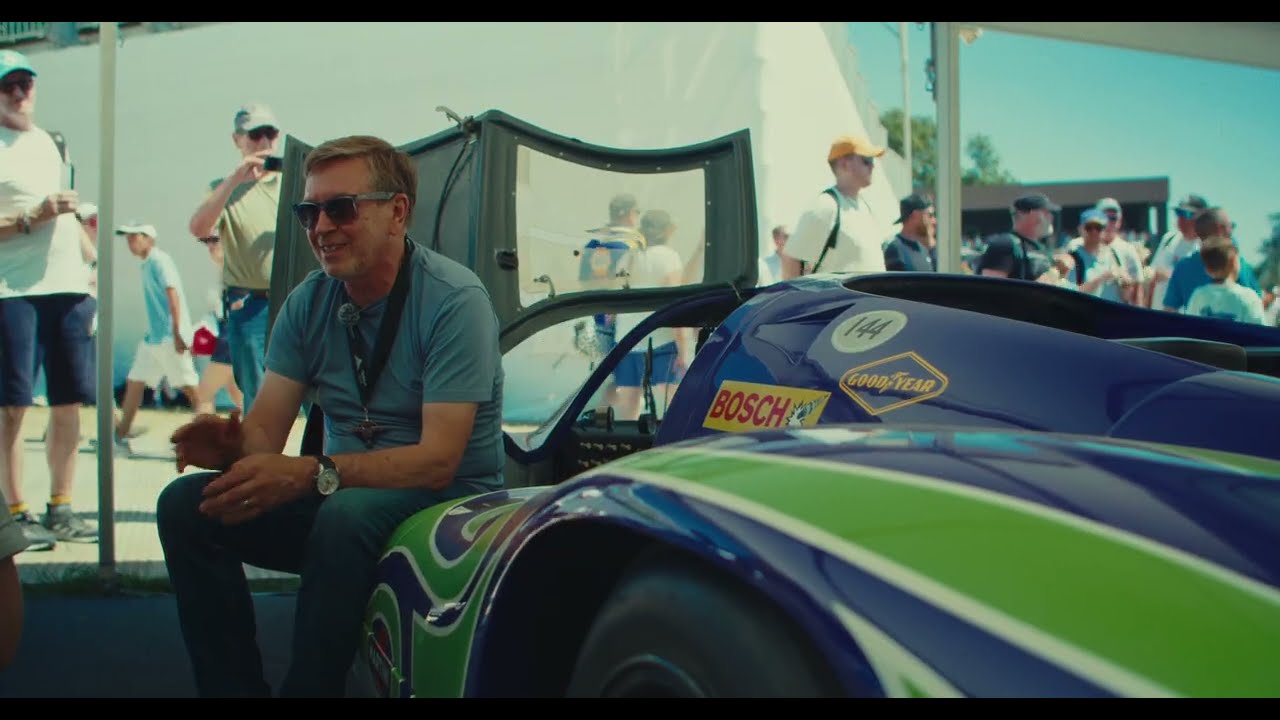
‘On the straight, the biggest problem was the spray — it was so thick that we couldn’t see,’ Gérard Larrousse, one of the car’s drivers, tells me. ‘When we arrived behind a 911, it was a complete fog. You had to guess whether to pass on the left or the right.’ Larrousse is 86 years old and, as we talk, he signs autographs from passing punters, mesmerised first by the car and then from his recollections of driving it. He sits in his race overalls with a twinkle in his eye, clearly delighted to once again be driving the world's fastest painting. ‘This car was the first 917 I ever drove. It was prepared for Le Mans, and when we arrived at Le Mans it was in a certain livery,’ he says. ‘And then the day after, it had another one, this one you can see now, which is very nice.’
Looking at the ‘Hippie Porsche', as the car soon became known, is a reminder to the assembled younger generation (myself included) that they weren’t the first people to invent sex, drugs and rock & roll. ‘The car came at a time of enormous cultural change,’ Frank Sytner, its co-owner, explains. ‘We’re talking about the Woodstock era. It was an amazing period of change and exciting new developments. The hippie movement and the psychedelic era introduced so many new ideas. It was a changing attitude to life, and designs like this came from imagination that may well have been influenced by….’ Sytner pauses, with a knowing smile, ‘certain chemicals.’


The Hippie Porsche existed not only at a time of cultural change, but engineering too. Purpose built for Le Mans, it never raced on another track, and was designed purely to make the most of its immense top speed on the various straights of the Circuit de la Sarthe, which in 1970, was even straighter than it is now. It existed at an inflection point between digital and analogue design. ‘It was really man versus the elements — a combination with no outside aid, no sat-nav, no ABS. Just a guy in a car,’ says Frank. ‘The 917 wasn’t designed by a computer. It was designed by a gentleman with a pencil and a piece of paper, drawing what he believed would be the most aerodynamically effective machine.’
‘That became the basis for what followed. The cars that came afterwards are still fantastic machines, but they followed the path the 917 pioneered. Motorsport has always been about pioneering spirit — that has been the part of its foundation from the very beginning.’
In 1971, the car returned to Le Mans, qualifying on pole and recording the fastest-ever top speed and lap time in the process, a record that stood for 37 years. Sadly, the psychedelic colour scheme was lost, with the Gulf Wyer team re-painting the car in its own blue and orange livery. It was sold to the Czech car dealer Vasek Polak, who in turn sold it to Massimo Padrazzi, who planned to race it in the South American Interseries. Alas, Padrazzi decided to build his own car, a Sabre D4, and the 917 was considered lost, spending 47 years hidden away in Padrazzi's garage, until it was sold to its current owners in 2024.
All around us, engines begin to sputter into life, and whistles blast. It’s time for the Porsche 917LH-043 (to give it its full title and chassis name) to once again stretch its legs up the Hill at Goodwood, and the small tent fills with smoke and thunder. A pioneering piece of art, a pioneering piece of engineering, an assault on almost every sense, makes its way to the start line, traced by countless eyeballs. Pioneering and unforgettable, almost 60 years later. A trip, in more ways than one.
