‘Doctors estimated they were two hours from death’: Around the world in 20 days — in a hot air balloon
Adam Hay-Nicholls speaks to Bertrand Piccard and Brian Jones, the first people to circumnavigate the globe in a hot air balloon.


The last great challenge in aviation was to circumnavigate the globe non-stop in a hot air balloon. Rival teams comprised of the world’s top aeronauts and billionaire adventurers were in a race to enter the history books. In 1999, the Swiss explorer Bertrand Piccard and a British flying instructor, Brian Jones, teamed up to beat Richard Branson and company to the prize. Their Bristol-built craft, the Breitling Orbiter 3, was a capsule that looked like a mini-submarine, with portholes and dozens of propane tanks strapped to it. The silver balloon, towering 55 metres above, was the shape of a giant cocktail shaker. It is a story that’s been revisited, 27 years later, in a new documentary called The Balloonists. Bertrand and Brian would have to overcome extreme weather, a near-fatal technical failure and mental and physical exhaustion as they cruised at the same altitude as airliners for 20 days straight.
'I always failed for a different reason, until there were no more reasons to fail'

Sunrise through the balloon window.

Brian Jones photographed above the Sahara Desert.
It’s a tale of derring-do that was imagined for centuries. In 1783, a soldier-aristo, Marquis François d’Arlandes and a physics teacher, Jean-Francois Pilatre de Rozier became the first human beings to fly. Their craft was an untethered hot air balloon, invented by brothers Joseph-Michel and Jacques-Etienne Montgolfier, and it floated over Paris for 25 minutes. The hot air balloon became a symbol of Romanticism, and was prominent in art and literature, such as the works of Jules Verne. In the 20th century, things moved fast. In 1903, Orville and Wilbur Wright took to the North Carolina sky in the first airplane, built from wood and cotton. Sixty-six years later, Neil Armstrong, Buzz Aldrin and Michael Collins rocketed to the moon and back. With the first successful airplane circumnavigation without refuelling having been achieved in 1984, piloted by Dick Rutan and Jeana Yeager, there was just the one major aviation record left to achieve: to fly non-stop around the world in a balloon, passing through each meridian and achieving a minimum distance of 22,859 miles carried only by the wind. No one knew if it was even possible.
Eleven-year-old Bertrand witnessed the launch of Apollo 11 on July 16, 1969, with his own eyes. That’s when he decided he would become an explorer. There was a family reputation to uphold. His father, Jacques, was a famous oceanographer and engineer, and a guest of honour in Cape Canaveral. In 1960, he rode a submarine 10,911 metres down to the bottom of the Mariana Trench, the planet’s deepest abyss. Bertrand’s grandfather, the wild-haired, moustachioed and bespectacled Auguste, was the inspiration for the Tintin character Professor Calculus (or Professeur Tournesol, in the French editions). He was a physicist, inventor and balloonist who became the first to reach the stratosphere in 1931 in a capsule built by a beer-barrel cooper. The Star Trek character Jean-Luc Picard is another nod to the Piccard legacy. In total, six members of the Piccard family have been pioneering balloonists. ‘This is such a massive cliché in the filmmaking world, but this is like a Wes Anderson film that’s also a true story,’ says John Dower, The Balloonists’ director.

The Alps seen through the capsule window.
The hyper-focused Bertrand had already suffered a couple of failed attempts with Orbiters 1 and 2. ‘I learned that after a failure, you should not try again the same way,’ says Piccard. ‘This is probably where Breitling Orbiter 3 succeeded where many of my competitors failed, because they tried the same thing over and over with exactly the same results. I always failed for a different reason, until there were no more reasons to fail.’ Orbiter 3 was all-new; new technology, new strategy, new overflight permissions and new trajectories. But the weather is hard to predict.
‘Bertrand falls out with a lot of people,’ notes director John (Lockerbie, Sophie – A Murder in West Cork, Louis Theroux’s My Scientology Movie), ‘and I think we can all identify with that in the workplace.’ Somewhat irascible, he’d split with two co-pilots when, a week before his third and final attempt, he asked his trusted technician Brian Jones if he’d like to fly. Brian, a gentle, disciplined, unflappable former RAF pilot from Somerset, checked with his wife Joanna (Jo) and, with her blessing, jumped headfirst into the mission despite, according to Jo, not normally being a particularly adventurous sort.

Brian Jones adjusting controls.

Bertrand Piccard (left) and Brian Jones (right).
She’d been an air stewardess. Their first date was a hot air balloon ride, followed by the pub. Brian got into ballooning in the mid-1980s, thrilled by the challenge and charmed by its joviality. ‘I was just mesmerised by it. There’s a mystery to it, because you never know where you’re going to end up,’ he says. ‘It’s one of the few things where people will still pull over their cars to wave at you, and trains toot when you pass over railway lines. There’s an old-fashioned romance. And, of course, most ballooners are eccentric oddballs.’
On March 1, 1999, Bertrand and Brian took off from the Swiss village of Château-d’Oex and began their eastbound voyage. For good luck, Bertrand had packed a copy of Guy de Maupassant’s A Life, inscribed by the author to Jules Verne, who had imagined such a flight in his 1863 novel Five Weeks in a Balloon. Verne loved A Life and kept it on his bedside table. Bertrand wrapped it in plastic to protect it in the event of an ocean ditch.
Brian was a little teary as he left Jo on the ground, and still is today when he reflects on that moment. Bertrand says it was more difficult for his family to say goodbye than it was for him. ‘When I look at my eyes in the film, I’m gone already. I’m already in the balloon. I’m not on the ground anymore.’ Jo took a crucial role in the control room during the flight, helping the crew to navigate their way around the world. She described it as going for three weeks without drawing breath. Another key supporting character is Belgian meteorologist Luc Trullemans, who did an extraordinary job of plotting the balloon’s route via the subtropical jet stream.
Following Luc’s altitude instructions, Bertrand and Brian managed to avoid restricted airspace over Yemen, which could have ended in a missile strike, and then thread a needle with a margin of just 30 miles 1,100 miles across China. On board was a 'unique, pressure-operated loo’ and a single bunk. The crew survived on freeze-dried rations, sleeping in shifts. There’s no autopilot in a balloon. ‘We had all sorts of issues with the systems, which was expected because it was completely untried and tested,’ says Brian, who tended to do the nighttime shifts. Night, particularly over the Pacific, was a scary time. There were thunderstorms around, and you couldn’t see the clouds. They were thousands of miles from land or any hope of rescue if they ditched. ‘The Parachute Regiment has a motto,’ says Brian. ‘Knowledge dispels fear. If you’re knowledgeable and well-prepared, you’ve got a pretty good chance of survival. But bad luck can strike. If you came down in the Himalayas or the Pacific, the chances of survival would be extremely remote.’

Their heating system failed. At high altitude, their drinking water froze solid, as did the windows. Stalactites were forming on the instrumentation and delicate electronic circuitry. The carbon-dioxide filters also froze, and this was very nearly deadly. The crew began to feel the effects of hypoxia: fatigue, dizziness and confusion. Brian awoke to find Bertrand slumped at his desk. He put oxygen masks on each of them, changed the filters, and they began to feel better. Doctors estimated they were two hours from death.
Traversing the Pacific was meant to take three days. It took seven, because the wind dragged them nearly 2,000 miles to the south. This ate into the fuel supply. ‘But then we saw this pink cirrus cloud, which often indicates the jet stream. It was exactly where Luc predicted it would be,’ says Brian. ‘The speed picked up and suddenly we were doing 100 miles-per-hour towards Mexico.’
With three-quarters of the fuel used up by the balloon’s six burners, the calculations said they wouldn’t make it across the Atlantic. A strong jet stream would be critical. It was a daunting risk, but Brian and Bertrand decided to go for it: Africa or bust. They jettisoned anything they didn’t need that was weighing them down. Using the last gasps of propane they soared to an altitude of 11,737 metres (38,507 feet) and caught a 142 mile-per-hour wind. The manoeuvre had worked: they crossed the Atlantic in a single day.
Twenty days and 25,361 miles after lifting off from the Swiss Alps, they’d circled Earth in their hot air balloon; a dream that had captured the imagination of adventurers, inventors and authors for centuries had finally come to pass. Having crossed an invisible finish line high above the Sahara, the pair came down in Egypt. Bertrand later told a press conference: ‘We took off as friends and we landed as brothers.’
In the film, Brian says the flight didn’t change his life. He was perfectly happy before, and today he and Jo raise alpacas in the Blackdown Hills. Bertrand says his life completely changed. In 2016, he completed the first round-the-world solar flight aboard the aircraft Solar Impulse. ‘I’m now working on Climate Impulse, which is a liquid green hydrogen airplane that I will attempt to fly around the world, hopefully in early 2030.’ This zero emission technology could become commercially viable. ‘None of this would have happened if I had failed with Breitling Orbiter 3.’
‘I really enjoyed the celebrity that came afterwards,’ says Brian. ‘It doesn’t last very long. My advice is to enjoy it while you can. For a while we did TV interviews and speeches, we had First Class air travel, limos, great hotels, it was just fun.’ He also picked up an OBE. ‘I met most of the Royals. The Queen was absolutely charming. Bill Clinton asked me for my autograph. We were at the Hay-Adams Hotel in Washington DC and he was there having dinner. He brought us over and said “Hillary’s going to be tickled pink when she knows I met you guys”. He was quite a character.’
The Orbiter 3 capsule now resides at the Smithsonian’s National Air and Space Museum. ‘It’s there with the Apollo 11 capsule and the Wright Brothers’ plane,’ says Bertrand, with great pride. ‘These things inspired me so much when I was a kid. I met Chuck Yeager, Charles Lindbergh, Armstrong, Aldrin, John Glenn, Alan Shepard, all these fantastic heroes of air and space. When I saw the capsule of my balloon next to their planes, rockets and spacecraft, my dream became real.’
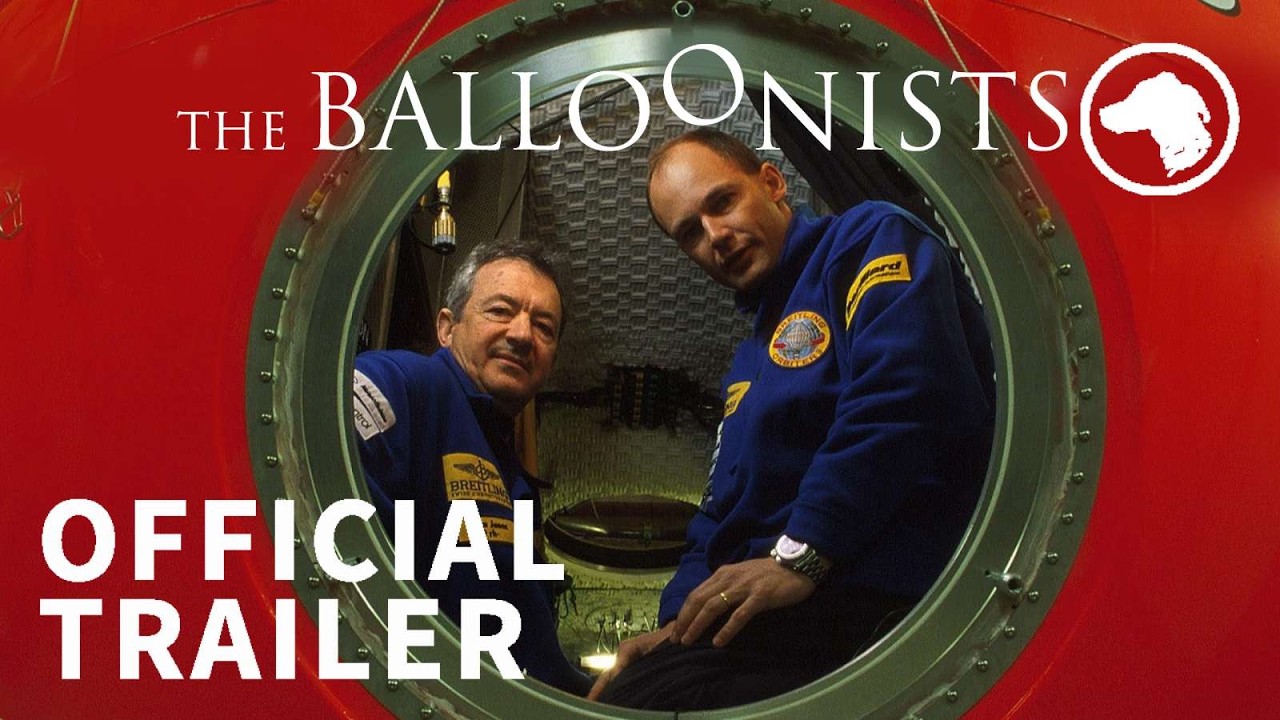
The Balloonists is an unexpected buddy movie about two very different men who balance each other perfectly, a love story between Brian and his wife Jo, and the incredible tale of how a third-generation pioneering Piccard set out to do what Jules Verne could only imagine.
