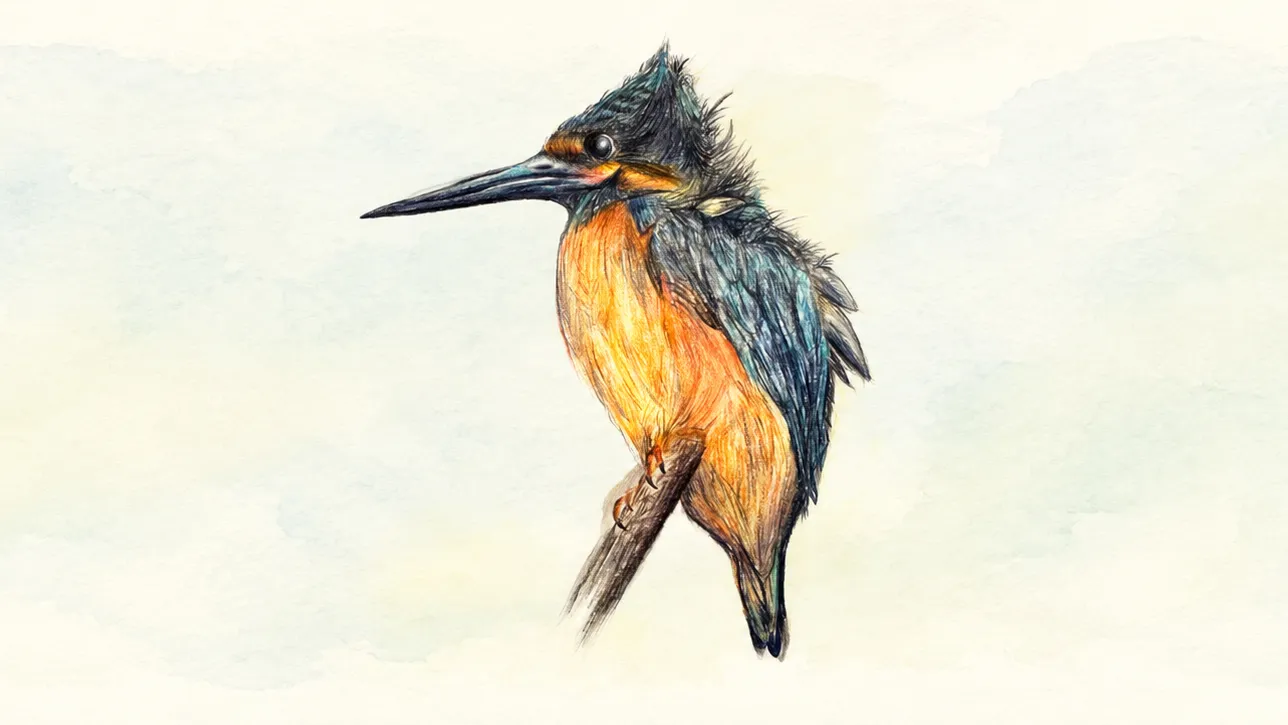
A picture of royal talent: Prince George's never-before-seen drawing of a kingfisher
Prince George is following in his mother's footsteps and learning to embrace the natural world — one drawing at a time.


A few weeks ago, The Prince of Wales appeared on Graham Norton's eponymous BBC chat show and revealed that if he wasn't destined to be Britain's future king, he might've trained as a policeman.
Looking at this drawing of a kingfisher, perhaps his son, Prince George, might've been an artist? It is, at least, a hobby he can pursue in his own time.
Prince George, age 13, completed the drawing a year ago and it is surely proof that his curiosity about the natural world is already taking flight. It also hints at a childhood spent looking beyond screens — something his mother, The Princess of Wales, revealed was incredibly important to her, in an exclusive interview with Country Life.
Subscribe to Country Life today and receive a copy of The Prince of Wales's Guest Edit free of charge 
Out of roughly 90 to 100 species worldwide, only the common kingfisher (Alcedo atthis) is native to the UK.
In Britain, was have perhaps 4,000 breeding pairs. It’s not found further north than central Scotland, as Highland rivers tend to be too rapid and peaty for the gaudy king to fish in.
Legend has it that the ‘fisher’ was originally grey, but was despatched by Noah from the Ark and flew towards the sun, scorching its chest and taking the hue of the heavens upon its back.
The kingfisher's vibrant plumage was once so valued by Imperial milliners, haberdashers and taxidermists that it was on the brink of extinction. In China, tian tsui ware involved the inlay of individual feathers on ornaments. River keepers persecuted the king. Old wives kept its skin in chests to preserve linen from moths. Anglers used the azure plumage for dressing flies, the very name of the bird seeming auspicious.
Haunting canals, meres and slower types of river, our alcedines are highly territorial and cut a dash along the water at speeds of up to 40mph. Their distinctive chee chee note is often heard upon alighting, when they will hunch on a handy perch, head tilted, beady-eyed as any invigilator. Occasionally, they hover over prey, like hawks.
The collective noun is, suitably, a ‘crown’, but it’s rarely applicable as these are shy and solitary creatures, except as breeding time approaches.

In Hieronymus Bosch’s triptych 'The Garden of Earthly Delights' (1490–1500), housed in the Museo Nacional del Prado in Madrid, a giant kingfisher — alongside other oversized birds appears in the central panel.
Greek legend had Alcyone (daughter of the wind god) throw herself into the sea when her husband, Ceyx, was drowned and they were transformed into kingfishers; thereafter, the wind was stilled for a fortnight each year so they could build their nests in tranquility, a period around the winter solstice known as the ‘halcyon days’.
The halcyon became a became associated with St Martin, the holy gravedigger and bringer in of winter — ‘Expect St. Martin’s summer, halcyon days,’ writes Shakespeare in Henry VI Part 1 and, in France, it’s known as Martin-pêcheur. Mariners would hang mummified kingfisher bodies on threads to act as a weathervane and, although the ingenious Sir Thomas Browne in 1646 demonstrated that two such skins generally gave contradictory directions, throughout the Renaissance, the halcyon was a byword for prophecy.
Significantly, it features in religious paintings as a symbol of peace (there’s a magnificent early depiction in Bosch’s Garden of Earthly Delights) something echoed by Milton; in On the Morning of Christ’s Nativity, he describes how ‘birds of calm sit brooding on the charmed sea’ and, although kingfishers never actually do that, the halcyon has a better claim to being a Christmas bird than our quarrelsome robin redbreast.
