When is a weed not a weed? When it's a wildflower
If cultivated plants are a sign of orthodoxy and order, are weeds symbolic of anarchy and wildness? Who really decides whether flora is wildflower or weed, asks John Lewis-Stempel.

It's not only beauty that is in the eye of the beholder. It is, we are assured, also the answer to that perennial query: ‘What’s the difference ’twixt a wildflower and a weed?’ The Oxford English Dictionary is definitive, defining a weed as a ‘wild plant growing where it is not wanted and is in competition with cultivated plants’.
The common dandelion (Taraxacum officinale), with its lovely golden head, will serve as an example. On the verge, we see it positively as prettifying, but growing on the grassy village cricket pitch, in front of the stumps, it is an obstruction that requires ‘weeding’. That’s that, then. The answer to ‘weed or wildflower?’ done and dusted.
Whether a wild plant is a weed or wildflower is a matter of its location — plus human perception. The moseying dog-walker admires the dandelion on the lane, the groundsman mowing the cricket pitch’s infield regards it as a problem. Ah, the dear old dandelion, put on Earth to rebut the wisdom of lexicographers and to weed out ontological glibness.
To itself, of course, Taraxacum officinale’s status as ‘wildflower’ or ‘weed’ is immaterial. It exists unto itself, what the German philosopher Immanuel Kant — who rather early got the hang of this being and perception stuff in The Critique of Pure Reason (1781) — posited as the state of ‘noumena’. Humans can only know things as they appear to us or as ‘phenomena’.

Dandelions look rather lovely in this photograph.
Neither do the 50 or so insects the dandelion supports care a fig about its classification, Kantian or otherwise. The bees of early spring are glad to visit it wherever it appears. They need the dandelion’s sweet pollen, which is as energy-giving as the primaveral sun.
In France, the dandelion, far from being in competition with cultivated plants, is a cultivated plant, a salad. Take note, too, of dandelion’s Latin tag, the officinale meaning that herbalists of the past granted it purpose as a medicinal herb — not a weed, or a wildflower mind you — and would have picked it wherever it popped up. Dandelion, among its medicinal attributes, is a powerful diuretic, hence its French name of pissenlit. Edible plants are plants. The end. Dig into history and the people of the past were clearly crop/weed/wildflower fluid.
Tollund Man, the bog-preserved corpse from the Danish Iron Age, consumed porridge containing cultivated barley and fat-hen (Chenopodium album) for his breakfast before being hanged. If the barley of his last meal was cultivated, the fat-hen may equally have been farmed or foraged.
Highly nutritious, the Iron Agers grew it or allowed it to grow — an eminently sensible approach to food provision: let the edible plant that flourishes flourish, whether wild and sown by breeze or planted by a horny-handed human with a digging stick. Fat-hen was sold by hawkers as a leafy vegetable in Britain as recently as the 18th century, yet today? It is a bane ‘weed’ of agriculture.
What did the Romans ever do for us? We may gawp in awe at Hadrian’s Wall and Bath’s baths, but the empire’s legacy also includes ground elder (Aegopodium podagraria), which was introduced to the isles as a pot herb. The perennial jumped the villa wall to take root elsewhere. As John Gerard noted of ground elder in his Herball (1597), ‘where it hath once taken roote, it will hardly be gotten out again’. Centuries of gardeners wail their woeful accord.
Those gardeners, together with small children, will doubtless be bemused to find that the plants once cultivated but now damned as weeds include the stinging nettle (Urtica dioica). Fairservice, the gardener in Walter Scott’s Rob Roy (1817), raised it under glass as an early spring green. Oh, the irony. What we regard as the ‘weeds’ of farm and garden were made more prolific by… farming and gardening.

Stinging nettles didn't used to be regarded as weeds.
The turning of soil favoured poppies and the midden — the farm muck heap — was a source of nitrogen beloved by the nettle. There was, however, in the past many a virtuous link between ‘weeds’ and farming, as recorded by the plants’ common names, which are often floral memorials of their ancient utility. Galium aparine, that sticky climber of the hedge, was known as ‘goose-grass’, as it was fed to goslings and Heracleum sphondylium, the airy white umbels of which liven the lane in June, was ‘common hogweed’, as it was free fodder for porcines.
Time has hardened the distinction between wildflower and weed. As agriculture rose and rose, the plants that competed with crops took on the negative nomenclature of ‘weed’, the word itself entering the English language in the 9th century. The division was more than botanical, agricultural, it was political.
Cultivated crops, especially cereals, became regarded as signs of orthodoxy and order, whereas weeds became symbols of anarchy and wildness. It’s there in Shakespeare, always the mirror to the age, when Cordelia says of her father in King Lear, Act IV, Scene 4: 'He was met even now/ As mad as the vex’d sea — singing aloud;/ Crown’d with rank fumiter and furrow weeds,/ With burdocks, hemlock, nettles, cuckoo- flowers,/ Darnel, and all the idle weeds that grow In our sustaining corn.' Or put plainly, Lear is an insane regent wearing a parodic crown composed of the parasitic weeds choking the grain that feeds his subjects.
By the opposite token, when Gerard Manley Hopkins railed against the Victorian taming of the countryside, his chosen emblem of poetic protest was weed, not ‘wildflower’: 'What would the world be, once bereft/ Of wet and of wildness? Let them be left,/ O let them be left, wildness and wet;/ Long live the weeds and the wilderness yet.'
When Hopkins wrote Inversnaid (1881), the industrialisation of agriculture was in full march and the weed became more than an issue, it became an enemy. The widespread use of chemical herbicides post-1950 allowed a Final Fix to the problem of ‘weeds’. One contemporary agrichemical company boasts its herbicides ‘fight weeds with a vengeance’. You and I might ponder whether or not flora is wildflower or weed, but ‘weedkillers’ rarely make such distinction.
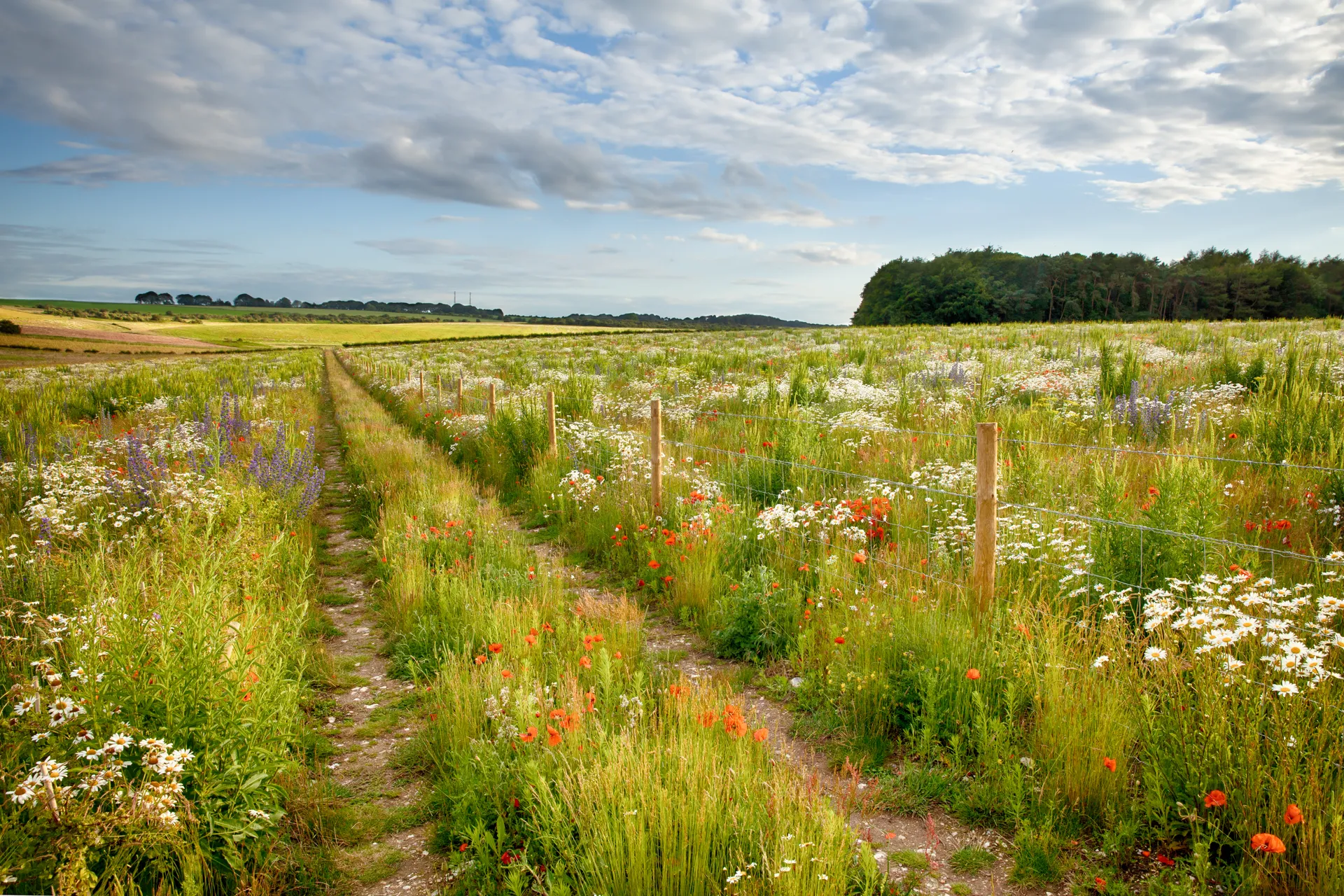
Weed and wildflower alike are to be suppressed. Hence all those monotone cereal fields across the land. The poppy (Papaver rhoeas) is the blood-red wildflower of Remembrance, yet for the maker of broad-leaved herbicide it is merely a menace to the sustaining corn. Thus is the cornflower (Centaurea cyanus), which is the blue of sky, condemned; so, too, the little scarlet pimpernel (Lysimachia arvensis), whose name is its description, pink and shyly peeking, and corn chamomile (Anthemis arvensis), elegantly limbed and sweetly daisy-headed.

In the eyes of a weed killer, this is a weed.
Weeds gave colour to the countryside, as well as food and habitat for our native creatures. When the weeds went, so did the wildlife. The grey partridge (Perdix perdix) declined by 92% between 1970 and 2013. The bird’s chicks are crucially dependent on insects whose hosts are arable ‘weeds’.
I am a serial re-creator of early Victorian wheatfields with their riotous wildflower/weed chromatics. I admit, my cereal yield has been a smidgeon less than conventional agriculture, but my arable wild plants have succoured the buzzing, flitting pollinators on which farming depends. The cattle have loved and thrived on the wild flora baled in the straw. I have gained, not lost. It helps to be pretty. Is that not part of the wildflower versus weed division?
I’ve deliberately sown corn chamomile, yet I have never sown broad-leaved dock (Rumex obtusifolius), a plant so plain Jane that Mrs Bennet would struggle to find it a suitor. My mistake. Although classified as ‘injurious’ in the 1959 Weeds Act, meaning that the government may enforce its removal due to toxicity/destructiveness, recent research from the Biological Husbandry Unit in New Zealand suggests that small populations of docks in pasture help prevent bloat in livestock, as well as providing mineral-rich nutrition.
The American philosopher Ralph Waldo Emerson was more right than he knew when he defined a weed as ‘a plant whose virtues have not yet been discovered’ — or have been forgotten.
This feature originally appeared in the June 24, 2026, print edition of Country Life. Click here for more information on how to subscribe.
