‘They don’t just fling themselves at you — they choose you’: Everything you need to know about the Scottish terrier
From Queen Victoria and Franklin D. Roosevelt to Rudyard Kipling and Humphrey Bogart — the Scottish terrier has been winning admirers for centuries, but it is a breed that chooses its people carefully.

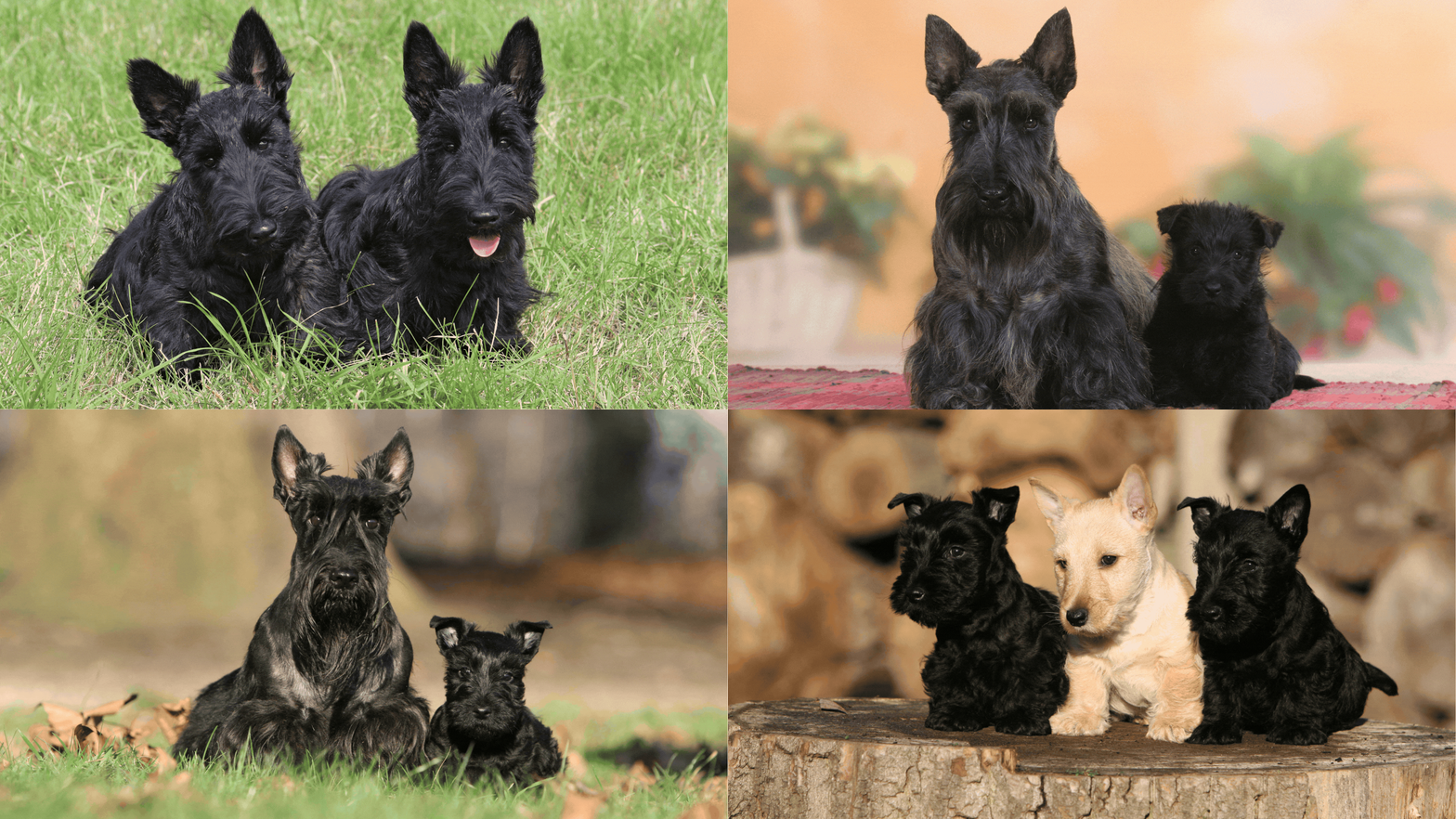
I’ve met a few Scottish terriers in my time, but sadly I’ve never had the chance to truly get to know one. After spending some time immersed in Scottie lore, history and owner testimony, I can confirm two things. First, I would now like at least two; second, they are sweet, short-legged little characters with a strong sense of self — just like me.
There’s a story that the earliest image of the breed appears carved into a Scottish Highlands farm wall. Dating from around 200AD, it depicts a short-legged, prick-eared dog barking at a wheelbarrow. It’s tiny, indistinct, open to interpretation and highly disputed — much like, I would come to find, most of Scottish terrier history.


What we do know is that for centuries Scotland needed small, fearless dogs capable of dealing with foxes, rats and other vermin in unforgiving weather and terrain. The result was a lovely muddle of terriers. As late as the 19th century, people were still arguing over what exactly constituted a ‘Scottish’ terrier, and whether such a thing even existed.
Out of the chaos emerged the low-to-the-ground, solidly built dog we know today. The Scottish terrier is purpose-built — sturdy rather than dainty, strong rather than speedy, with a head designed for scenting and a coat tough enough to withstand weather and wildlife. Judges place as much importance on the famous double coat as they do on the body itself, and for good reason. The outer coat is wiry, with a dense, soft underlayer — so dense, in fact, that dog show judges say you should be able to part it and still not see skin.
Today, black Scotties are by far the most familiar, but this wasn’t always the case. Once, wheaten Scotties (with a sandy coloured coat) were more common, until darker dogs gradually became the preference — simply because they were easier to tell apart from a fox when hunting. Practical, yes. Slightly bleak? Also yes.

Like Neapolitan ice cream — but better.
A literary Scottie
Rudyard Kipling was so devoted to his Scottish terrier, Boots, that he allowed him to write his own books — a trilogy, in fact. In The Servant a Dog, Boots recounts a day of mischief before anxiously wondering whether he has fallen out of favour with his owner. He imagines winning back his owner’s affection with gifts, games and earnest devotion — my dogs would never.
Can a gift turn Thee? I will bring mine all —
My Secret Bone, my Throwing-Stick, my Ball.
Or wouldst Thou sport? Then watch me hunt awhile,
Chasing, not after conies, but Thy Smile.
Someone firmly under their spell is artist Josephine Trotter. ‘I was always a collie sheepdog person,’ she tells me, until her children suggested something entirely different. Enter Peebles, Josephine’s first Scottie, who has ‘selective hearing’ and a punchy, protective nature, while Presley — who joined the fray after Peebles survived a near-fatal rat-poison incident — is ‘scatty and a bit mad’. They are, she says, very strong-minded, creatures of habit and entirely guided by food and routine — and so the similarities between us continue.
Josephine tells me they are independent and thoughtful, that ‘they don’t fling themselves at you — they choose you’. Pioneer breeder William McCandlish, who ran one of the leading Scottie kennels before the First World War, once described them as ‘almost human’ in character — and, Josephine agrees, you need to earn their love. ‘They are not lap dogs,’ she says, ‘but they are deeply loyal and rather enchanting.’

American beauty
In a 1944 presidential campaign speech by Franklin D. Roosevelt he addressed false claims that he had left his Scottish terrier, Fala, behind on a trip to the Aleutian Islands: ‘You know, Fala is Scotch, and being a Scot, as soon as he learned that the Republican fiction writers had concocted a story that I had left him behind on an Aleutian Island and had sent a destroyer back to find him — at a cost to the taxpayers of two or three million dollars — his Scotch soul was furious. He has not been the same dog since.’
Unlike her former collies, who were devoted and glued to her side, Josephine's Scotties are independent souls. They love walking, have formidable noses, enjoy car journeys and attending church. Presley is particularly fond of music — specifically, and most charmingly of all, the singing of the church choir.
Scotties have long appealed to royals, politicians and the famous. Queen Victoria kept them. James VI was said to be devoted to them, though this is also disputed. Franklin D. Roosevelt’s Scottie, Fala, became so famous he was the subject of political speeches. Writers, artists and actors have fallen for them for generations. Rudyard Kipling’s Scottish terrier, Boots, even wrote poetry — or at least, Kipling did on his behalf — imagining elaborate ways to regain his owner’s approval after a day of mischief.


Scottish terriers won’t worship you blindly. But if you want to earn their devotion — and a dog who will walk beside you rather than behind you — the Scottie might just be your breed.
Last week we turned the spotlight on the Siberian husky — read all about these remarkable dogs built to survive some of the coldest temperatures on earth.
