'We cracked the padlock and found a mountainful of asbestos, so that wasn't ideal': The secret spaces in our finest country houses
Secret spaces in country houses continue to thrill and spook us in equal measure.


Framed by spiky palms and overlooking the teal expanse of the Salcombe estuary in Devon, Overbeck’s, an Edwardian country house currently under renovation, harbours a secret that delighted me as a child.
Amid the curiosities collected by its eccentric owner was a hidden door. I remember the excitement of hunting for it and entering the dimly lit space beyond: a room with wall-to-wall dolls’ houses and petite proportions that were perfectly suited to a small child with a big imagination.
Decades later, my own children ran their tiny hands over the same dark-wood panels beneath the stairs, letting out appreciative squeals when they made their discovery.
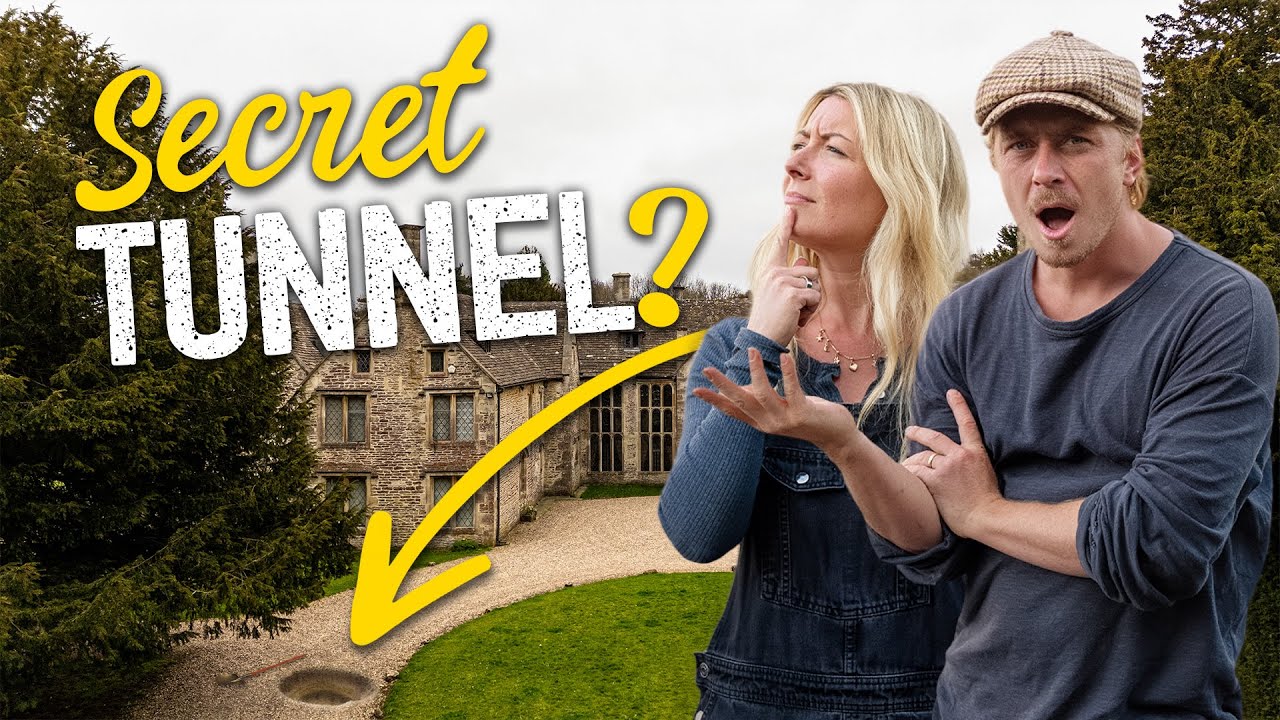
Our country houses are brimming with hidden spaces, quickening the pulse of all those who learn their secret. Chavenage House in Gloucestershire, subject of the YouTube channel Life at the Manor and fictional home of the O'Hara family in the Disney+ adaptation of Dame Jilly Cooper's Rivals, has proved ‘full of surprises,’ notes James Lowsley-Williams — who inherited the Grade I-listed Elizabethan property in 2023.
One day, in a passage leading to a library and billiard room, he noticed a groove in the panelling behind a large Jacobean chest. When he pushed the panel, ‘it popped open’ to reveal a heavy steel door and a hidden room beyond that couldn’t be found on any of the plans.
‘The library was actually the dining room for the original 500-year-old house,’ he explains and, because in those days ‘every meal was candelabras and silver cutlery’, this windowless room was its silver safe. He had hoped to find ‘mountains of gold’ or some silverware at least, but he was met with dusty books and disused furnishings.
His grandfather had more luck in the attic, where a hidden room contained designs signed by George IV for the remodelling of Windsor Castle. He sold them to the Crown and the proceeds paid for Chavenage’s new roof.

The Victorian Gothic armoury and staircase at Knebworth House. There are also a myriad trapdoors, hiding places and oubliettes.
Back in the 19th century, our fascination with the secrets hidden in country houses helped drive the trend for Gothic literature. As Allan Fea remarked in Secret Chambers and Hiding Places of about 1900: ‘In exploring the gloomy hiding-holes, concealed apartments, passages, and staircases in our old halls and manor houses we probe, as it were, into the very groundwork of romance.’
Edward Bulwer-Lytton, for example, drew on the trapdoors, hiding places and oubliettes of his ancestral home, Knebworth House, Hertfordshire, in The Haunted and the Haunters, in which the strange supernatural energy in the house is orchestrated from a room hidden beneath a hatch; whereas in Charlotte Brontë’s Jane Eyre, the garret occupied by Mr Rochester’s deranged first wife was inspired by the hidden attic room believed to have housed ‘Mad Mary’ at Norton Conyers in North Yorkshire.
Of course, in most country houses, hidden doors and secret passages served a primarily functional role. At Harlaxton Manor in Lincolnshire, a hefty jib door in the carved-oak panelling connects the great hall to the state dining room, allowing servants to move with discretion as they undertook their daily tasks.
Such doors were also an aesthetic choice, preserving the symmetry of an ornate interior. Yet even practical features were sometimes imbued with a proprietor’s sense of fun. In a false bookcase in the library of Oxburgh Hall in Norfolk, for example, the 6th Baronet included a volume titled La Porte, hinting playfully at the room hidden beyond.

Originally used in Tudor times as the larder and dairy, Hever Castle's former owner William Waldorf Astor converted the room into the Drawing Room in 1905. The beautiful panels are made from oak, bog-oak and holly and are each unique with the exception of one duplicate. One of them conceals the entrance to a secret passageway.
At Hever Castle, the secrets are constantly evolving. A discreetly hinged wall panel with holly and oak marquetry once provided access to a turret to launch surprise attacks on assailants. When the luxury-loving Lord Astor purchased the Kent castle in 1903, he saw no need for a defensive tower and hid something else behind the door more suited to his lifestyle: a cocktail cabinet.
This appetite for whimsy is still alive and well. Andrew Tolochko of Solid Carpentry, which creates bespoke designs for clients in the London area, has noted an increase in requests for hidden features. ‘For many, it’s their dream from childhood,’ he tells me, whereas others are inspired by James Bond. Projects include a mirror concealing a home office and a hinged bookcase opening onto a lift to private apartments.
‘When the door is closed, you’d never guess there is something behind it,’ he says. Some clients have security in mind and request hidden panic rooms or vaults. ‘It elevates the interior, but it also has a function,’ explains Tolochko, who believes that a hidden space helps a property stand out to buyers and can even increase its value.
Witley Park in Surrey is one such unforgettable property, its secret a testimony to the extraordinary imagination of its flamboyant former owner, the mining speculator and financier James Whitaker Wright. Beneath its lake, a glazed tunnel leads to a glass-domed underwater ballroom (now derelict), its apex marked by a statue of Neptune rising from the water. ‘Outside the clear crystal glass is a curtain of green water, and goldfish come and press their noses against the glass,’ reported the Royal Magazine in 1903.
Hidden spaces serving to save lives rather than impress visitors were no less creative. Baddesley Clinton in Warwickshire, where Anne Vaux and her sister Eleanor ran a safe house for Jesuits during the Reformation, has three priest hides or holes: in the roof, behind wood panelling and in a shaft leading to the sewers accessible only by rope.
The cleverly hidden spaces outsmarted the persecutors, who, she says, ‘behaved like a lot of boys playing blind man’s bluff, who, in their wild rush, bang into tables and chairs and walls and yet haven’t the slightest suspicion that their playfellows are right on top of them and almost touching them’.
During Oliver Cromwell’s pursuit of Royalists, these hides found a second life. At Boscobel House, Shropshire, Charles II sought refuge in one beneath the attic stairs — only fractionally more comfortable than the oak tree he famously hid in on the estate.

You'd never know that the grill to the right of the fireplace in Edinburgh Castle's Great Hall conceals a secret chamber.
In times of conflict, knowing the secrets of a country house — its underground passages and hidden stairways — gave the owner power over their visitors. In some cases, that extended to eavesdropping on guests, particularly political rivals.
In the Great Hall of Edinburgh Castle, a metal grill to the right of a colonnaded fireplace is the only clue to a secret chamber beyond known as a ‘laird’s lug’ (lord’s ear), where James IV once listened in on his subjects. Centuries later, in 1984, this primitive wiretap would unsettle the KGB, who insisted it be bricked up when Soviet leader-to-be Mikhail Gorbachev visited.
There are some secluded spaces, however, that you’d rather not know about. ‘Horrific’ and ‘terrifying’ are the words Lowsley-Williams uses to describe a tiny room up a stone stairway discovered by his grandfather: a prison cell, with a stone seat and barred window, and reportedly haunted. The discovery of a disused boiler room was also inauspicious. ‘We cracked the padlock and went down and then found a mountainful of asbestos, so that wasn’t ideal,’ he admits.
For better or for worse, heritage properties continue to give up secrets that are sometimes centuries old. In 2023, conservation work at Johnstown Castle in Co Wexford, Ireland, revealed a mysterious circular room hidden behind a bricked-up wall in a tower and accessible only by boat.
It may be ‘a small turret bedroom’, the castle manager told the BBC. ‘We will need to investigate this further.’ Meanwhile, in the Cotswolds, Lowsley-Williams’s latest find in his 50-room home has also left him perplexed. ‘The question’s still out there,’ he tells me. ‘What do you do with an unused vault by your library? If any of your readers have any ideas, let me know.’
This feature originally appeared in the July 29, 2026, issue of Country Life. Click here for more information on how to subscribe.
