
Scottish estates in demand
After the uncertainty of the independence vote, Scotland is back in business.

In contrast with 2014, when Scotland’s Independence Referendum brought the market for Scottish sporting estates grinding to a halt, there is little sign of a similar knee-jerk reaction taking place in the wake of the Brexit vote on June 23. In fact, some leading Scottish agents maintain that the post-Brexit decline in the sterling exchange rate has reawakened interest among overseas buyers—always an influential element in this rarefied marketplace.
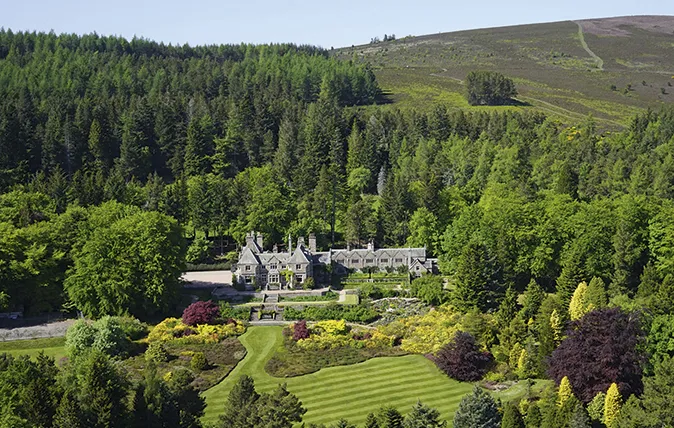
As Rob McCulloch of Strutt & Parker (0131–226 2500)—who earlier this month launched the prestigious, 12,000-acre Tillypronie estate (Fig 1) near Tarland, Aberdeenshire, at a guide price of ‘offers over £10.5 million’— explains: ‘In a normal year, I would expect to see about 20 sporting estates launched on the market in Scotland: in 2014, there were only seven. Last year, there were 19 and this year looks like being another average year, with 20 or so estates being offered for sale, and 13 either sold or under offer, although with September a key period, we won’t be able to draw any firm conclusions until the year end.’
With its first-class driven game-shooting, the unrivalled setting of its mansion house and gardens and its majestic position straddling Deeside and Donside on the eastern fringe of the Grampians, Tillypronie rightly belongs in ‘the top drawer’ of Scottish sporting estates, with something for everyone, the agents say.

At its heart lies imposing Tillypronie House, a spectacular 11-bedroom mansion built in 1867 by Sir John Clark, the diplomat son of Queen Victoria’s physician, Sir James Clark. Not only did Her Majesty lay the foundation stone, but she often visited the house with her friend and confidant John Brown. Other notable visitors included the American writer Henry James, who described it as ‘this supremely comfortable house—lying deep among the brown and purple moors... [with] the glorious view of sweeping hills and gleaming lochs that lies forever before the windows’.
James’s appreciation is shared by Philip Astor, the current owner of Tillypronie, who has enjoyed this ‘truly magical place’ since inheriting it from his father more than 30 years ago. Historically, the estate boasted one of the most prolific grouse moors in the Highlands, with a regular average of 2,000 brace a year in his father’s day in the 1960s and 1970s, and Mr Astor has worked hard in recent years to restore the grouse moors to something approaching their former glory.
He is also proud to have developed the renowned high-bird Towie pheasant shoot, within the steep-sided valleys of three tributary burns feeding the River Don. Tillypronie also offers roe-deer stalking, rough shooting and duck-flighting, trout fishing on a number of lochs and salmon fishing on the Don.

Vendors of highly priced Scottish estates—and their agents—will be encouraged to hear that the 4,175-acre, residential, farming and sporting Fettercairn estate (Fig 2) in Aberdeenshire has gone under offer, following its launch in June for ‘offers over £15m’ through Savills. For sale as a whole, or in four lots, at its heart is a grand, 22,880sq ft, Jacobean mansion, created around a 17th-century core, by William Burn in the 1820s and Robert Lorimer in the 1890s, and beautifully renovated by the present owners.
The sale includes 22 further estate houses, 1,345 acres of arable land, 281 acres of pasture, 1,840 acres of rough grazing and 562 acres of commercial and amenity woodland.
Following the sale in lots, through Savills and CKD Galbraith, of the Cayzer family’s 5,400-acre Kinpurnie estate in Angus after it failed to find a single buyer at its original £29m asking price, Savills (0131–247 3720) and Davis & Bowring (01524 274430) are joint agents in the sale of the 21,768-acre Tulchan estate (Fig 3) on Speyside, whose guide price of ‘offers over £25m’ makes it the most expensive ‘whole’ Scottish estate currently on the market.

Described as ‘a sporting Utopia’ and ‘simply one of the best all-round sporting estates in Scotland’, Tulchan occupies a glorious position on the edge of the Cairngorms National Park and is easily accessible by road, rail and air. Running through the estate is Scotland’s third longest river, the majestic River Spey, whose eight miles of double-bank fishing has earned Tulchan Water the accolade of one of the finest stretches of fly water in Europe.
In addition, the estate offers red-and roe-deer stalking, two driven grouse moors, hill-loch fishing and an ‘esteemed’ driven pheasant shoot. Overlooking the Spey valley at the heart of the estate is Tulchan Lodge, a 13-bedroom Edwardian shooting lodge built by George McCorquodale in 1906 and ideally suited to large house parties, with alternative accommodation provided by the modern stone-built, six-bedroom Knocktulchan Lodge and a number of holiday cottages scattered around the estate.
It’s all vested in a limited company, Tulchan Sporting Estates Ltd, which is wholly owned by the vendors, Derbyshire businessman Leon Litchfield and his wife, Gillian, who bought the estate in 1993. Transfer of ownership will be effected by means of a sale of the shares in the company, whose assets also include a productive in-hand farm, five let farms, extensive natural woodland and forestry and various development sites.

Evelyn Channing of Savills is also handling the sale of the historic and picturesque Leckie estate (Fig 4) near Gargunnock, Stirlingshire, previously owned by former Scottish Secretary Sir George Younger, 4th Viscount Younger, who died in 2003, and, following the death of his widow, Diana, is now being sold on behalf of their family.
An ancient and originally much larger estate owned by the Crown, Leckie was granted to Malcolm de Leky in the 1350s. The Leckies remained in possession until 1668, when the estate was sold to the Moir family of Craigarnhall, in whose hands it remained until 1906, when it was purchased by the 1st Viscount Younger, who came from a long-established Scottish brewing family.
Beautifully positioned in relation to both Edinburgh and Glasgow, Leckie enjoys a wonderfully peaceful setting with magnificent views to the west and north towards the Trossachs. Following the sale of the former main estate house, the new, five-bedroom Leckie House was built in 1962 and, from 1992, was the Youngers’ much-loved family home.
The present, 1,546-acre estate, comprising Knock-O-Ronald Farm with a four-bedroom farmhouse, a cottage, farm buildings, 1,000 acres of pasture, rough grazing, woodland and lochs and an established pheasant shoot, plus farmland, a grouse moor and a further cottage, is for sale at ‘offers over £3.38m’ for the whole, or in four lots.

Buyers who yearn for space and solitude can find plenty of both in Sutherland, where the diverse, 4,057- acre Gruinards estate (Fig 5) near Ardgay, 50 miles north of Inverness, is for sale through the Edinburgh office of Goldsmith & Co (0131–476 6500) and Bell Ingram in Bonar Bridge (01863 766683), at ‘offers over £1.5m’.
A substantial mixed Highland sporting estate with a traditional Victorian shooting lodge in the heart of Strathcarron, Gruinards stretches from the banks of the river Carron across rich grassland to heather-clad moorland and the mountains beyond, however, being within an hour’s drive of inverness, it’s relatively accessible from most major UK hubs.
The main estate lodge, completed in 1897, was designed in Baronial style by A. Maitland & Sons and built from stone quarried in the grounds. it features a prominent four-storey tower with battlements, enhanced by some beautifully crafted stone-masonry. The interior reflects a similar level of craftsmanship in the pitch-pine panelling, plasterwork and fireplaces of the principal rooms.
The house was extensively renovated in the 1980s, when it was rewired throughout and had a new central-heating system put in. Bathrooms were also upgraded and, more recently, a new kitchen was installed.
The formal gardens surrounding the house include a number of mature trees and shrubs, a large variety of rhododendrons, and an en tout cas tennis court cleverly concealed within a nearby walled garden.
Elsewhere in the grounds, a former curling pond and a Victorian water garden evoke the more leisurely pursuits of a gentler age, although more robust sporting opportunities are readily available on the hills, lochs and woodland of the estate.
**Seach more country houses for sale in Scotland
