Why these 'portly old gentlemen in dinner suits’ might be our nation's favourite bird
Clourful and compact, puffins are one of the nation’s most beloved seabirds. Stephen Moss reveals why these parrots of the sea fit the bill.

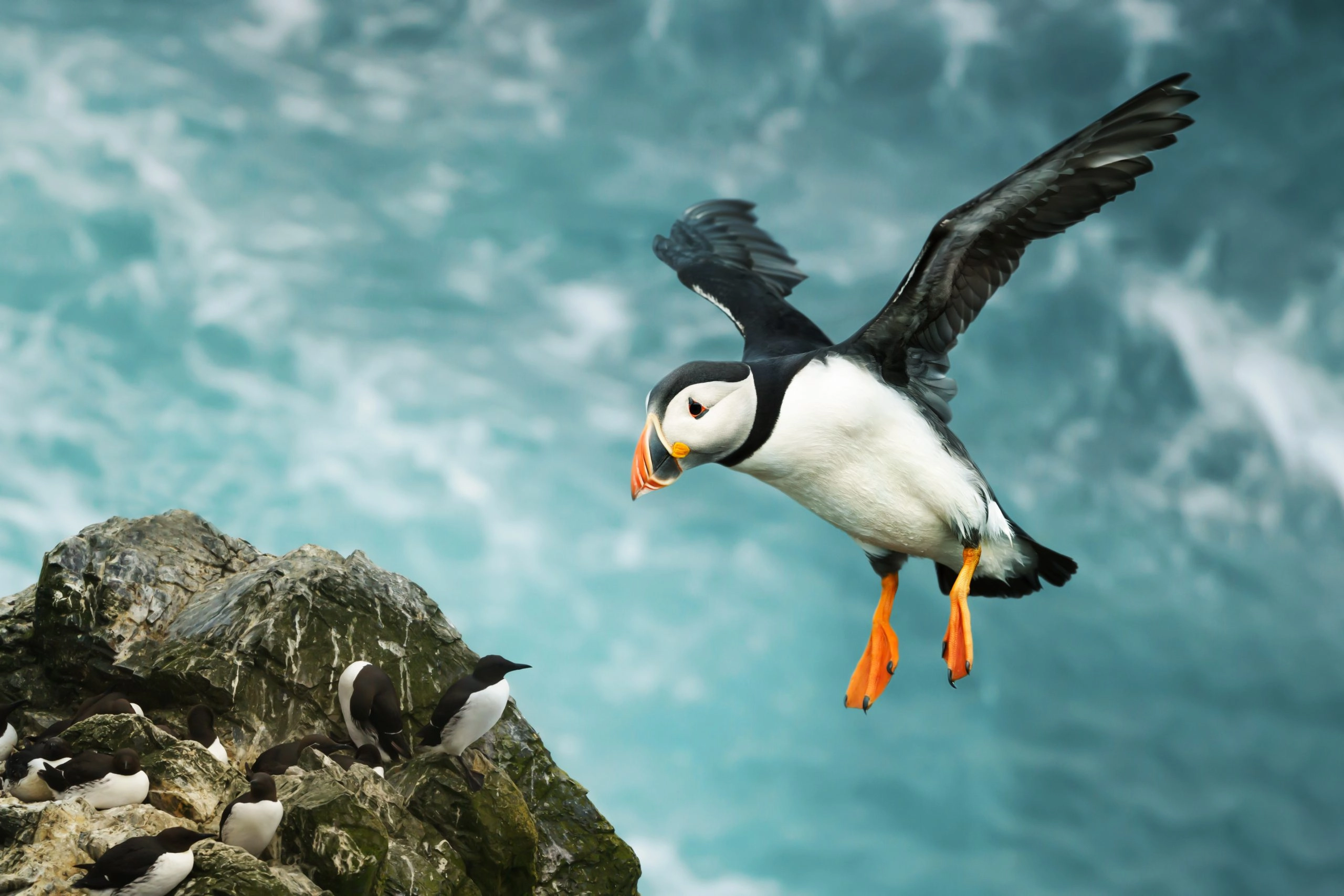
You have to make a real effort to see a puffin. They are only with us for a few months when they come ashore between April and July to raise their single chick in huge, noisy colonies on Britain’s offshore islands and coastal cliffs. Outside the breeding season, they are almost impossible to spot, as they spend the autumn and winter far out to sea, mostly in the North Atlantic Ocean.
- Puffins don’t use their webbed feet to swim underwater; instead, like penguins, they ‘fly’ with their short, but powerful wings. They are capable of reaching depths of up to 230ft beneath the surface
- When they are airborne, they can flap their wings at up to 400 beats a minute, rendering them a blur to the human eye
- Puffins have specially elasticated bills with serrated edges, which enables them to hold several sand eels without dropping them. They usually carry between 10 and 20 at once, but some have been observed clutching more than 80
- Their parrot-like bill, which they are so famous for, is only large and brightly coloured during the breeding season. In autumn, puffins shed the colourful plates and their bill becomes much smaller as a result. They begin to regrow them the following spring, just before they come back to breed
- Our puffin’s official name is the Atlantic puffin, which differentiates the species from its two close relatives, the horned and tufted puffins, which are found in the Pacific Ocean
- About 90% of all of the world’s Atlantic puffins are found in Europe, with more than half in Iceland. Large numbers also breed in Norway, Britain and the Faroe Islands. On the western side of the Atlantic, they breed in Canada, the north-eastern US and Greenland
Despite this, not only is the puffin by far and away Britain’s best-known and best-loved seabird, it could be argued that it rivals the robin as our favourite avian resident. And yet, unlike the robin — and almost all the other birds we feel a deep affection for — puffins are not part of our everyday lives.
If you decide to go to see puffins, you won’t be disappointed. The first thing you notice as you approach any seabird colony is the noise, as tens of thousands of birds shriek and shout their haunting calls at one another. The second is the smell — seabirds produce an awful lot of guano. Only then, as you finally get closer, do you appreciate the sight of this incredible avian spectacle, aptly described by the conservationist Roy Dennis as ‘Britain’s Serengeti’. The best-known puffin colonies are on Skomer Island off the coast of Pembrokeshire in south-west Wales, the Farne Islands off Northumberland and Lundy Island in North Devon — the very name of which derives from the Old Norse word for puffin, lundi.
If you are not very comfortable on boats, don’t worry; you can visit the onshore RSPB reserve at Bempton Cliffs, East Riding of Yorkshire. Before I explore the fascinating behaviour of this charismatic little seabird, where does its curious name come from? I’m afraid the origin isn’t very flattering: ‘puffin’ basically means ‘fat’, which seems rather apt. This doesn’t refer to the adult birds — which Bill Oddie likened to ‘portly old gentlemen in dinner suits’ — but to the even more corpulent young birds.
As with so many bird names, even this derivation is far from straightforward. The word ‘puffin’ originally referred to the young of another seabird, the Manx shearwater. As puffins do, shearwaters nest in burrows and used to be harvested, then cured and salted as food, described by one observer as ‘an esteemed delicacy’.

At least puffins weren't saddled with another folk name, ‘clown of the sea’.
The word was then Latinised and used as the scientific name of the Manx shearwater Puffinus puffinus, but, at some point, the English version was transferred to our favourite seabird and it stuck. I rather wish we had kept the earlier name, ‘sea parrot’, which derives from that extraordinarily colourful and parrot-like bill. At least it wasn’t saddled with another folk name, ‘clown of the sea’ (from the bird’s somewhat doleful expression), which is rather less flattering.
The new rat-pack: the Gen-Z team saving shearwaters and killing invasive species on a remote island in the Irish seaHaving spent as long as eight months out at sea, diving below the surface to feed, and coping with wind, waves and storms, both male and female puffins return to their breeding colonies in late March or early April. Almost as soon as they arrive, they begin their courtship display. First, they swim around one another on the surface of the sea, then they rub those colourful bills together and make affectionate sounds — not unlike human beings kissing and whispering sweet nothings to their partner. Only once the pair bond is fully secure will the birds return to their burrow, where they will raise the chick.
The pair cannot always use the same burrow as the year before: it may have been destroyed by winter storms or already be occupied by rabbits or even a rival pair of puffins. If they need to dig a new burrow, they first use their surprisingly strong bill like a pickaxe to cut the soil, then use their equally powerful claws to move the earth out of the hole. When this work is complete, the female will lay a single, pale egg, which she and her mate take turns to incubate for the next 40 days or so. Once the chick, known rather sweetly as a ‘puffling’, hatches, the real work begins.
Every day for the next few weeks, both parents must fly out to sea to find food — mostly small, slender fish called sand eels — to satisfy their voracious offspring. Flying from, and especially back to, the nest is a risky business. Puffins are small and light — less than 12in long and weighing less than a pound — so they are extremely vulnerable to much larger predators such as gulls and skuas. These expert hunters will wait for the puffins to return to shore, then give chase and harass them until they give up the fight and drop their precious catch. However, puffins are feisty birds and, despite this apparently unequal contest, many do manage to evade their attackers and bring the precious sand eels back to their hungry chick.

Puffins rub their bills together and make affectionate sounds before mating.
Roughly six weeks after the puffling has hatched, it has put on an enormous amount of weight, growing from about 0.1lb at birth to as much as 0.7lb — not far off the weight of its parents. This is the equivalent of a newborn human baby reaching the weight of a seven- or eight-year-old child in just over a month. Now is the time to leave the safety of the burrow and experience the outside world for the very first time. This is the most dangerous moment in the chick’s short life because those formidable predators will snatch it if they can.
Even when the young puffin does manage to survive, fledge and fly away to sea, like all our seabirds it faces many threats. Problems include marine pollution — puffins are especially vulnerable to oil spills — and the climate crisis, which is already making its food supply less predictable as sand eels head further north away from the colonies. Human intervention has managed to reverse some population declines, successfully increasing the number of breeding puffins on Lundy and the Isles of Scilly by eradicating rats, which used to feed on the eggs and young chicks.
Seabirds have a special place in our culture and folklore; none more so than the puffin. Not surprisingly, given their endearing, clown-like appearance, they are especially popular in children’s books, television series and films. A friendly puffin, Sven, makes an appearance in the celebrated series of penguin-centric films Happy Feet and a more villainous character, Hans, features in The Penguins of Madagascar television programme.

Puffins must work hard to feed their young.
The best-known cultural impact of the species appears in the name of the most enduring and successful children’s publishing imprint, Puffin Books. This was founded in April 1940, five years after the launch of the groundbreaking series Penguin Books and three years after Pelican Books. In almost a century since, these books have sold in their millions and inspired generations of children to enjoy reading. Whenever a child or a parent picks one up, they will come across the distinctive logo on the book’s spine, showing this curious little seabird so beloved by us all.
‘The Puffin: A Biography’ by Stephen Moss (Chatto & Windus, £14.99) is out now
See more of the best skip the rest — add us as a preferred source in Google and you'll see more from Country Life when you're online.
This feature originally appeared in the November 4, 2026, issue of Country Life. Click here for more information on how to subscribe.
