Why a watch should be anything but round
A clock is often round, but a wristwatch can be many different silhouettes.

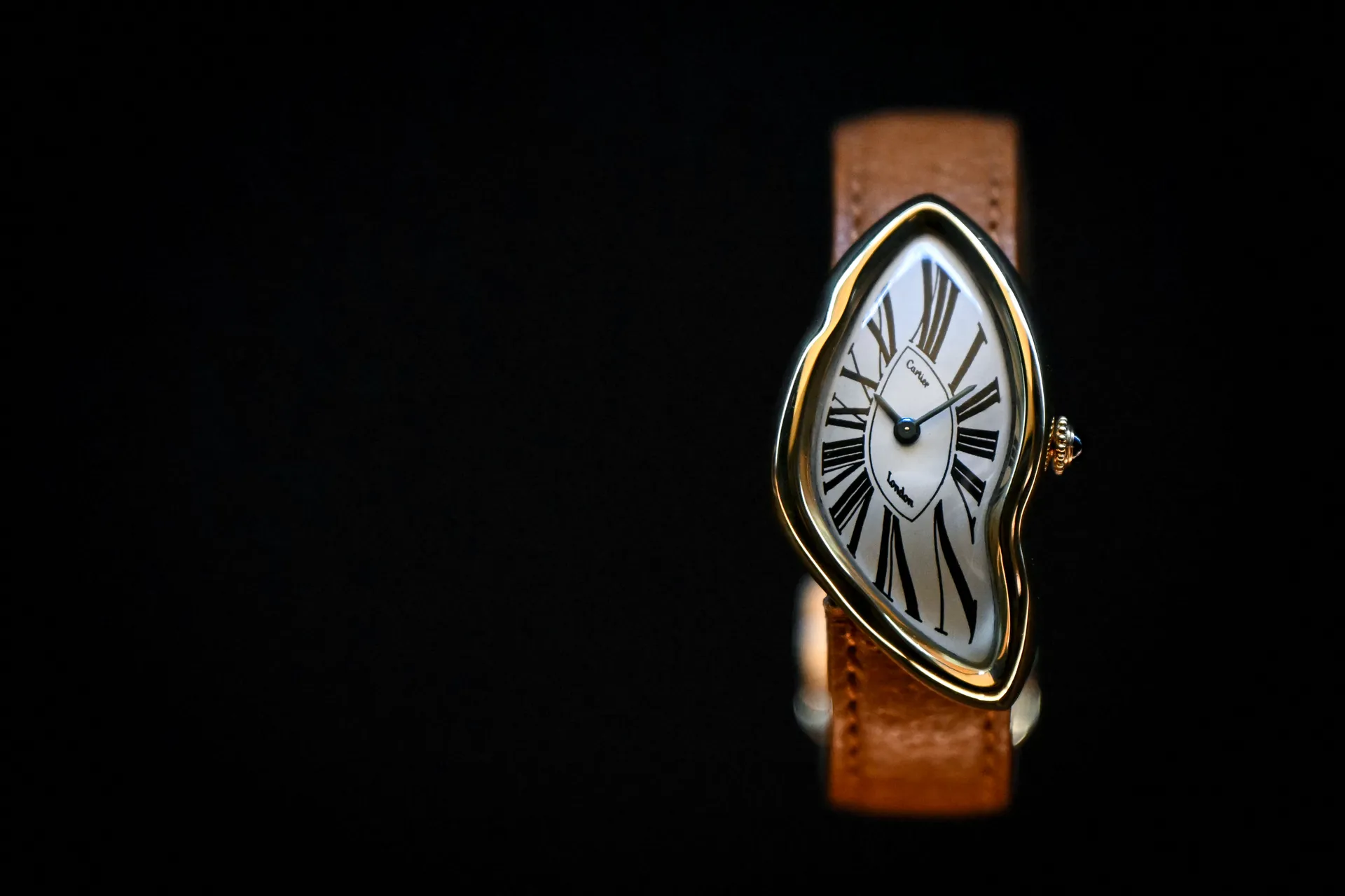
It is always a pity to sully the pleasures of collecting watches with the taint of filthy lucre, but the soaring value of a certain model of wristwatch can function as a helpful barometer of shifting tastes.
Five years ago, one result in particular sent the mercury shooting up the scale to command the attention of the market. Trophy models by Patek Philippe and Rolex frequently fetch six- and seven-figure sums, but, on November 10, 2021, after fierce bidding, a Cartier Crash watch from 1970 quadrupled its low estimate of 200,000 Swiss francs to sell for 806,500 Swiss francs.
It was an astonishing result, made all the more remarkable because included in the sale was an insurance valuation for the watch from 1997 that valued the watch at £40,000.
The Cartier Crash was invented in the London branch of the famous jeweller in the late 1960s. Until they were reunited in the 1970s, Cartier’s three main boutiques, in Paris, London, and New York, were separately owned by different members of the family and were known for producing their own distinct styles of products.
For instance, for much of the first half of the 20th century, the London branch conducted a brisk, sometimes roaring trade in tiaras, because they were still required for Court occasions, coming-out balls and so on.
But, by the 1960s, London Society had changed: King’s Road fashions rather than Queen Charlotte’s ball dictated tastes and Cartier reflected this shift in the centre of social gravity, offering groovy designs with strange shaped cases and bold dials with large Roman numerals.
Of these far-out creations, none was further out than the Crash. The name referred to the watch’s creation myth that a timepiece damaged by a car crash had been brought in for repair. Everything about the watch was, to use a technical term, wonky: the case asymmetrical, the buckle twisted off centre, even the concealed lugs, invisible when the watch was on the wrist, were at crazy angles. It was so strange that even Cartier was unsure about issuing it, as I was told some years ago by Dennis Gardiner, a veteran designer of Cartier London, who started work in 1947.
‘Mr Emmerson [Mr Gardiner’s colleague and co-designer] was a great designer and I think there was a little bit of the Salvador Dalí in the Crash. Mr Cartier would not make it at first. He said it was too much like Carnaby Street of those days, but the first one sold immediately and they became a cherished item.’
Even so, they were too avant-garde for many traditional Cartier customers. Stewart Granger bought one, but returned after a week to exchange it for something more conventional. Such was their complexity of manufacture that only about a dozen were made in London in the late 1960s and early 1970s and a couple more on very special order during the 1990s.

The Cartier Privé Crash Skeleton is limited to 150 numbered pieces.

Elvis Presley is presented with a limited edition Rolex King Midas watch in a special presentation case shaped like an Ancient Greek vase, for his run of concerts at the Houston Astrodome Livestock Show and Rodeo in Texas, in 1970.
London Crashes are true grail watches, but even more common, later examples made in larger numbers by Cartier Paris are increasingly sought after. In the 21st century, the design has been revisited and reinterpreted, including this year, with the release of the Cartier Privé Crash Skeleton in platinum. The collector's item first received a skeletonised dial treatment in 2015, nearly 50 years after the watch's debut, but the 2026 itineration marks the introduction of a new movement, designed to fit and follow the warped case.
However, although it may be the most spectacular of shaped case watches, the Crash is far from being the sole non-round wristwatch to find popularity in recent years. Nor is the shaped case a new thing: indeed, it is as old as the wristwatch.
In 1810, the Queen of Naples commissioned a watch from Breguet that is believed by some to be the first wristwatch. Known as No 2639, it took 2½ years to make. Emmanuel Breguet, the current historian of the Breguet brand, describes it as 'of revolutionary construction and unprecedented sophistication, consisting of a repeating watch with additional refinements, oblong and exceptionally slender with a wristlet made of hair intertwined with gold thread’.
Although this watch is commemorated by the Breguet brand today with a distinctive, egg-like oval watch for women, it would be another century before the wristwatch began to be taken seriously.
'During the Battle of Omdurman in 1898, British soldiers wore pocket watches in cup-like wristbands'
As the 19th century drew to a close, the practicality of the wristwatch for active men began to be appreciated: during the Battle of Omdurman in 1898, British soldiers wore pocket watches in cup-like wristbands. Yet even during the early decades of the 20th century the jury was still out as to whether watches should be worn in the waistcoat pocket or on the wrist and many wristlet watches, as they were called, continued to be made from converted pocket watches or ladies pendant watches.
It was in order to stress their modernity that designers of purpose-built, rather than converted, wristwatches chose non-round designs. In this, Louis Cartier was a leader, making the small, square Santos wristwatch for the eponymous Brazilian-born aviator, who was a frequent sight in the skies above Belle Epoque Paris, scooting about in his powered airships.
The best non-traditional watch releases of 2026 so far

- Bulgari’s Octo Finissimo The latest iteration weighs a mere 65 grams. Its name is a nod to the 37 millimetre, geometric case
- Bulgari Serpenti Aeterna The serpent-shaped bracelet watch now comes heavily encrusted in jewels (122 in total)
- Chopard L’Heure du Diamant(above) The case of this 1970s-style, cushion-shape watch is framed in 4.4-carats of diamonds
- Piaget Sixtie High Jewelry Cuff This sculptural cuff watch is a miniature work of art, rendered in rose gold, diamond and opal
- Vacheron Constantin Historiques American 1921 The cushion-shape case and skewed dial — it's at a 45° angle — are designed to be better for telling the time when your hands are on the (car) wheel. It's now available in pink gold, 105 years after its release
The Santos set a precedent and, emboldened by its success, even more esoteric models were launched including Tonneau, which found favour with the ultra-modern composer Stravinsky; the tortoise-shaped Tortue; the bell-shaped Cloche; and, of course, the Tank with its numerous derivatives. These watches are spectacular to look at and, after many years in the shadows, Cartier has once again reissued many of its quirkier watches to be worn by both women and — since the trend for oversize watches has receded — men.
Cartier was not alone in adopting non-round shapes to differentiate its early wristwatch production. At roughly the same time, Patek Philippe was supplying the Brazilian jeweller Gondolo with tonneau and rectangular watches shaped to follow the curve of the wrist — so significant were these watches that, even to this day at Patek, a non-round watch is called a Gondolo.
At Vacheron Constantin, between 1919 and 1921, a cushion-cased wristwatch was created for the American market. It was made truly different by the presence of the winding crown at the top right-hand corner of the case, roughly where one would expect to see half-past one. In 2021, the watch was revived, to appeal to 21st-century tastes.
This year is the 95th anniversary of one of the most famous of non-round watches, the Jaeger LeCoultre Reverso, a watch that, as its name suggests, can be turned over on the wrist. This innovation was conceived to protect the watch glass, the most fragile part of the watch at the time. Although synthetic-crystal watch glass has long ago obviated the need for such a protective measure, the flip-over functionality has remained as an opportunity for including either a second face for the watch, with additional functions, or as a canvas for the artists at Jaeger to use to embellish its appearance.
Whether engraved with a coat of arms or decorated with enamel painting (some art-collector clients have even had their paintings reproduced in miniature), the effect can be eye-catching.
Today, the visual effect of the shaped case wristwatch is winning new converts. When Rihanna was photographed announcing her first pregnancy, she wore a pink anorak and ripped jeans, festooned with jewellery. Distended abdomen aside, it was her wrist that attracted attention. She was wearing one of the rarest of Rolexes, the King Midas.
First appearing in the early 1960s, the King Midas used solid gold throughout. ‘Never before — a watch so daringly new, so outrageously different, so harmoniously classical. Named after the legendary king with the golden touch, sculptured from a block of solid 18-carat gold, the King Midas is a watch designed for the most discriminating people in the world’ enthused an early advertisement.
Straight on one side, angled to a point on the other, when laid flat on its edge it evokes the pediment and tympanum of a classical building. ‘We created this as a modern tribute to ancient Greece’ explained one tagline.
Even the box was truly remarkable, taking as its inspiration a masterpiece in the British Museum, the famed Midas stamnos, a lidded pottery vessel combining aspects of vase and amphora that was created in about 440 BC. The black ground is decorated with red figures depicting Silenos led before Midas.
I never saw Rihanna as a student of classical antiquity, but it seems that the strangely shaped Rolex King Midas has finally brought out her inner Mary Beard.
