‘Live in the country (or, failing that, Kensington Square) and wear navy’: A brief history of the colour that never goes out of style
Deborah Nicholls-Lee takes a look at how the colour navy got its name — and why its still a safe bet, centuries on.


In 1982, The Official Sloane Ranger Handbook by Ann Barr and Peter York laid out the rules for navigating upper-class society. ‘Live in the country (or, failing that, Kensington Square)’, ‘read Dick Francis’ and pass the port clockwise at dinner parties. ‘It’s not just a rule, it’s traffic sense,’ explains the handbook. However, at the very top of the list is a simple sartorial command: ‘Wear navy’.
‘The importance of navy blue goes right through the wardrobe. It always looks right,’ the guide opines. ‘It is discreet, safe, [and] grown-up.’ I have to agree. I still wear a navy Guernsey jumper that belonged to my father in the 1970s. It now has moth holes, but is somehow still smart.

The Princess of Wales wore a white and navy Jenny Packham dress to her first public engagement of 2024.
Navy is a colour that takes itself seriously and sends out important signals about status and rank. The navy pinstripe suit was once the epitome of power dressing and a favourite with City bankers, while the navy blazer with shiny gold buttons has long been popular with royals and became the signature look of the indefatigably debonair Sir Roger Moore. Queen Victoria kickstarted a trend for navy-and-white sailor suits when she dressed four-year-old Prince Albert Edward, later Edward VII, in one in 1846; at last year’s Trooping the Colour, The Princess of Wales and Princess Charlotte wore coordinating nautical-inspired, navy and white outfits. Meanwhile Princes George and Louis appeared at the event in double-breasted navy blazers — just as their father and grandfather had done when they were boys.
Back in 2010, when The Prince and Princess of Wales announced their engagement to the world, they again turned to dark blue, echoing the rich blue of the sapphire engagement ring. Commenting on The Prince of Wales’s choice on their website, bespoke tailors Henry Herbert remarked: ‘The timeless, elegant and ever-sharp navy blue suit will never let its gentleman wearer down, on the most daunting or momentous of professional or personal occasions.’

William Lang — pictured in here in the 1890s — was a captain in the British Navy. The Royal Navy underwent a period of radical transformation during the Victorian era (1837–1901) with iron and steel warships powered by steam taking the place of its fleet of wooden sailing ones.
The colour’s association with formality and style has much to do with the naval uniform that gave this darkest of blues its name. Army officers were the first to wear a uniform (in 1748), but they had to supply their own. The decision to make it dark blue was pragmatic. ‘It was really just taken from fashionable dress,’ explains Dr Amy Miller, fashion historian, curator and author of Dressed to Kill: British Naval Uniform, Masculinity and Contemporary Fashions, 1748-1857. ‘Pretty much everyone in the 18th century owned an indigo-dyed coat with brass buttons,’ Amy tells me, so it was the obvious choice for the uniform.
Indigo dye, shipped from the colonies, was abundant and very hardwearing. ‘It’s a really good colour in terms of holding colourfastness and it’s not fugitive, so if you pack it away, it’s not going to leach out onto anything that surrounds it,’ says Amy.
True to its origins, navy is a colour that still transports me to the sea. As a teenager, I spent long summers in cut-off denim shorts, and navy-striped rugby and Breton tops, clambering in and out of dinghies with salt-streaked legs. Decades later, I remain a slave to nautical fashion and the permanent place in my wardrobe afforded to navy blue owes much to these happy memories.

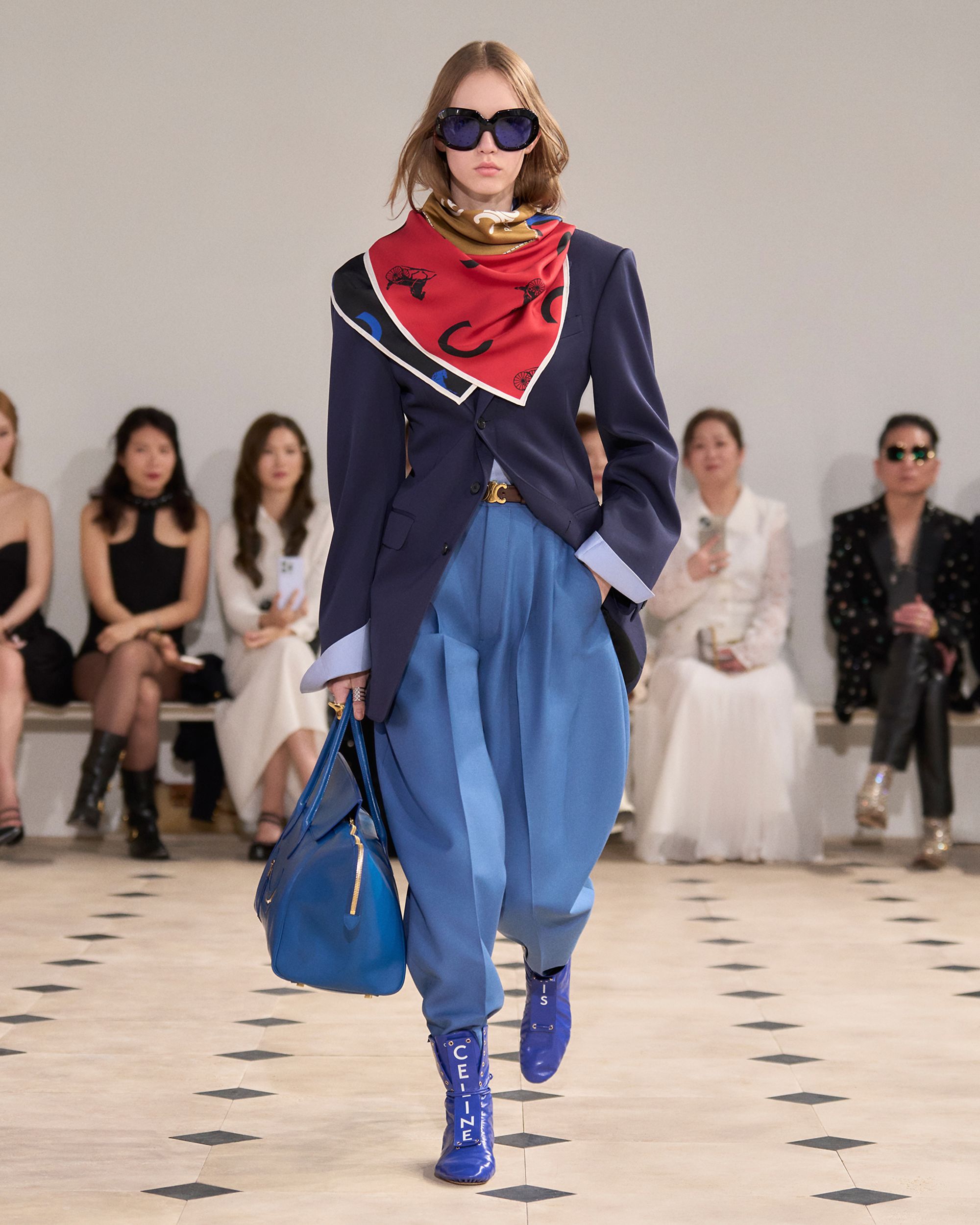
Fortunately, my enduring love of navy is endorsed by the highest arbiters of fashion. Chanel, who helped popularise the colour in the 1920s with its chic, nautical-inspired looks, was inspired by its own heritage in its 2025/26 Cruise collection. Meanwhile, Celine’s 2026 Spring collection is an important lesson in how to use navy to anchor brighter shades. For a more classic look, turn to Ralph Lauren, navy’s unofficial ambassador and an expert in harmonising it with ivory, chambray and camel.
The colour might have an upstanding reputation today, but the Navy’s navy was born of bad behaviour. ‘They had a real image problem,’ says Amy. ‘They were seen as men who had been away too long at sea in the exclusive company of other men … They were crass and known for being the most profane swearers.’ At the time, the Navy was the country’s largest employer — ongoing conflict and colonial expansion required manpower — and a new uniform was a key part of a strategy to rehabilitate their reputation.
That bad reputation was eventually blown out of the water (no pun intended) by a series of spectacular naval victories, including the Battle of the Nile, the Battle of Camperdown, and the Battle of Trafalgar. In the wake of these dazzling wins, The Times published a fashion feature proclaiming the Navy’s uniform’s inky blue shade as the hot new thing and giving it its new name — navy. ‘[Wearing navy blue] was a really good way for people to engage and to show their patriotism,’ says Amy.
Some of our oldest schools have embraced a navy uniform, too. At Harrow, a dark blue blazer is paired with a varnished straw hat and matching ribbon; Oundle is famous for its natty navy-pinstripe culottes and it was the affordability of blue and yellow dyes that dictated Christ’s Hospital’s uniform. Almost 500 years later, students still wear the belted navy two-piece and buttercup-yellow knee-high socks.
Navy blue has also seeped into luxury and high street fashion. In Country Life guest editor Sir David Beckham’s wardrobe, you’ll find modern versions of the Admiral’s great coat, introduced in the 1800s, and the pea coat, issued to ratings a century later. In November, Lady Victoria Beckham watched Sir David receive his knighthood while wearing a navy dress from her own label. ‘Navy is more in fashion than it has ever been,’ says stylist Alex Longmore, whose clients have included Jodie Kidd, Zara Tindall and Dame Joan Collins.

The 2025 Venice Film Festival was awash with navy — often with fabulous flourishes. Amanda Seyfried’s Prada navy silk dress was embellished with a bold red bow, while the navy satin of Julia Roberts’ Versace gown was broken up by a striking black harlequin pattern. ‘There’s something so chic about wearing black and navy together,’ says Alex. The pair made headlines — wearing navy of course — when they turned up to separate photocalls in the same outfit.
People feel they can trust navy, explains Alex. It ‘behaves well’ in an outfit. It’s a shade that demands respect, though, so pairing it with neons can look ‘a bit confusing. The colours don’t really merge’. Her other tips include not wearing too much navy all at once and — permit me to pat my navy-clad self on the back — always having a navy-stripe Breton top to hand (paired with jeans and an oversized jacket). For inspiration, Alex suggests looking to Gwyneth Paltrow. ‘Gwyneth is someone who gets wearing navy just so right,’ she says. ‘She wears quite a lot of cream cashmere [with it] and is quite preppy in her style’.
Navy is a popular colour with people in high-profile positions. ‘I’ve turned to navy blue when people have something formal to do and they don’t want to stand out, but they don’t want to wear something as somber as black,’ says Alex.
More than 40 years have passed since the publication of The Official Sloane Ranger Handbook, but the rules still hold. ‘There’s almost a cheapness to black now that there isn’t with navy blue,’ says Amy. ‘Black is so ubiquitous. Navy is a cut above.’
